Menu
stage img
  • Focus

Jon Mathieu | “It gets awkward when you start questioning the very existence of the places that people call home.”

03.10.2025 – Interview: Theodora Peter

Historian, ethnologist and mountain expert Jon Mathieu on Switzerland’s Alpine identity and the social impact of natural disasters.

The Blatten landslide has brought people in the Lötschental valley together. Can we say the same about Switzerland as a whole?

Jon Mathieu: It is probably overstepping the mark to claim that a landslide has brought the whole country together, but there has clearly been a nationwide wave of solidarity. It was particularly touching to see numerous donations from small municipalities – communities that had no real obligation to help the people of Blatten, but did so anyway. The president of the National Council tapped into this sentiment when she opened the summer session of parliament by mentioning the disaster in a short address entitled “Together for Blatten – a country stands together”.

Jon Mathieu, born in 1952, is professor emeritus in history at the University of Lucerne. He was founding director in 2000 of the Centre for the History of the Alps at the Università della Svizzera italiana. Photo provided

Why do natural disasters engender this sense of togetherness?

It is all to do with empathy and that feeling of belonging. People stick together in difficult moments. This does not mean we suddenly all become bosom buddies; the rat race will go on as it always has. But the immediate response is to want to do something. This, essentially, is a ritual that dates back centuries. During the Reformation, men made monetary and material donations – known as “gifts of love” – mainly to their fellow brothers in faith. This tradition was revived when Switzerland became a country in its own right, albeit recipients were now both male and female. This new phase began after the Goldau landslide of 1806. The “Landammann” (chief magistrate) of Switzerland made an appeal for donations. It was the moment when people got their first inkling of a new era after the demise of the Old Swiss Confederacy.

How are the Alps intertwined with Switzerland’s identity? And has our relationship with the Alps changed over time?

The first suggestion of any Alpine identity dates back to the 16th century, when a number of scholars began to refer to “Alpine people” – not least to emphasise that they were less than keen on being affiliated to the Holy Roman Empire. But it was not until the late 19th century and the opening of the Gotthard railway in 1882 that this identity became important. The railway line was the new federal Swiss state’s pride and joy, signalling to the entire (Western) world that we were a mountainous nation. The national exhibitions of 1914 in Berne and 1939 in Zurich made a big play of it. Both events happened to take place shortly before the World Wars – two difficult periods in Swiss history. This national identification with the Alps has waned since the 1960s, although the rest of the world continues to associate Switzerland with mountains.

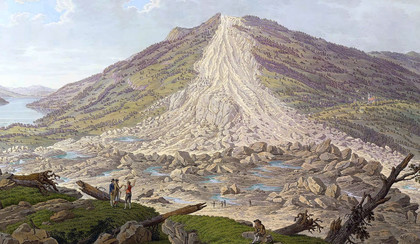
The Goldau landslide in 1806 was met by a wave of national solidarity. The first nationwide campaign for donations was launched following the disaster. Image: Keystone

Can we dare to talk about the costs and benefits of protecting ourselves from Mother Nature – or even consider vacating certain Alpine valleys altogether?

By all means, but then we risk the ire of those communities affected. Basel was rebuilt after the 1356 earthquake, they will say. No one would consider evacuating Zurich or Berne either if the Limmat or Aare burst their banks, as they have done in the past. It gets awkward when you start questioning the very existence of the places that people call home. People on the ground weighing up the costs and benefits are not always best placed to make those decisions either. To date, no one has analysed this complex issue over a long period from a scientific viewpoint.

www.labisalp.usi.ch

More on this topic:

Thawing ice, crumbling mountains – and a threat to human life
The devastating landslide in Blatten (canton of Valais) shocked Switzerland. Are exposed mountain valleys really still safe to live in? Scientists warn that the likelihood of cataclysmic landslides and mudslides in the Alps will only increase with climate change.

An avalanche destroys the Valais village of Blatten
An ice and debris avalanche completely destroys the Valais mountain village of Blatten (News “Swiss Review 3/25 July”).

Comments

×

First name, surname and place/country of residence is required

Enter valid name

Valid email is required!

valid email address required

Comment is required!

Comment rules have to be accepted.

Please accept

* These fields are required.

top