Thawing ice, crumbling mountains – and a threat to human life
03.10.2025 – Theodora Peter
The devastating landslide in Blatten (canton of Valais) shocked Switzerland. Are exposed mountain valleys really still safe to live in? Scientists warn that the likelihood of cataclysmic landslides and mudslides in the Alps will only increase with climate change.
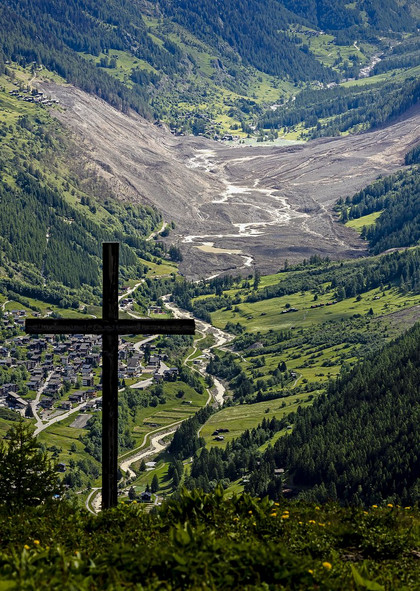
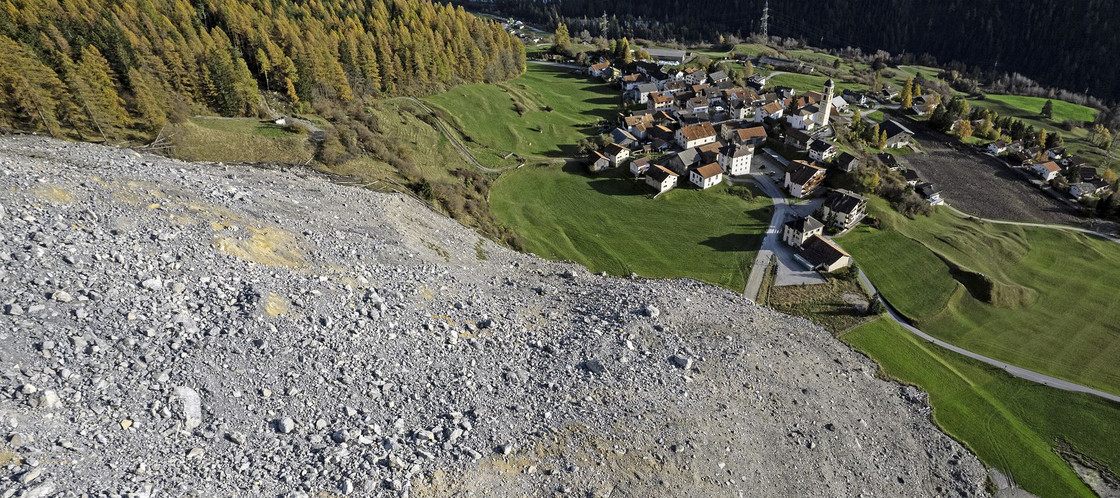
The view over the buried village of Blatten. The layer of ice and debris is two kilometres long and up to 100 metres deep. The avalanche of debris thundered into the valley from the left, reaching as far as the hamlet of Weissenried on the right-hand side. Photo: Keystone
The Valais village of Blatten was wiped out on 26 May 2025, when some ten million cubic metres of rock and ice plummeted into the Lötschental valley. Blatten’s residents, who had been evacuated to neighbouring villages two weeks before, watched in horror as the Birch Glacier came thundering down the side of the mountain at 3.30 p.m., burying their village.
A fatal chain reaction triggered the disaster. In the preceding days and months, parts of the Kleines Nesthorn mountain had begun to break off, piling up on the glacier below. The ice groaned under the enormous strain – before finally giving way. According to the scientists at ETH Zurich, who have been monitoring the glacier and the Kleines Nesthorn since the 1990s, climate change is likely to have contributed to permafrost thaw and increased rockfall. They see parallels between Blatten and the landslide that ripped through the Grisons village of Bondo in August 2017. Back then, an approximately three-million-cubic-metre rockslide on the Piz Cengalo mountain landed on a small glacier, causing some of the glacier to be swept away. This sent a river of mud, rocks and dirt flooding into Bondo. Eight hikers were killed. The inhabitants of Bondo got the shock of their lives, with the debris flow causing extensive damage to homes and roads. To protect the village from future threats, the authorities have invested over 50 million Swiss francs in protective infrastructure including a dam to prevent flooding.
Plans for a rapid rebuild
Blatten’s 300 residents have lost everything they own. The landslide claimed the life of a man who had been on the way to his sheep and was later found dead. Barely a day after the disaster, local mayor Matthias Bellwald declared that Blatten would be rebuilt. “We have lost our village, but not our heart,” he said – a quote that was seen around the world. Only two weeks later, the Communal Council pledged to rebuild the village within the next five years. It was important to say that Blatten had a future and that it was possible to rebuild, said Bellwald in July when “Swiss Review” visited him in the neighbouring village of Wiler, from where the mayor is continuing his duties.
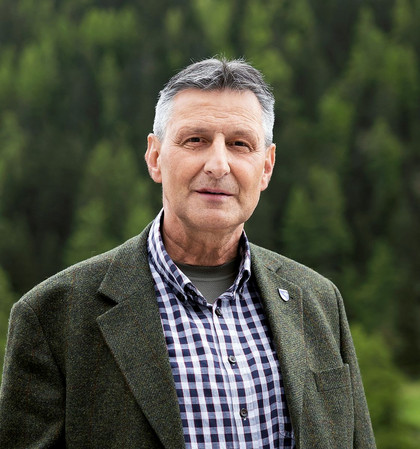
Blatten’s mayor Matthias Bellwald does not want to give up on his village: “This is our home and our land.” Photo: Keystone
Some 80 per cent of Blatten’s residents have remained in the Lötschental valley after finding other places to stay. Happily, there was no exodus. One reason for that is because children from Blatten have always gone to school in Wiler and Kippel. “Continuity is crucial for our schoolchildren,” says Bellwald. After the shock and trauma, adults in the village community must adjust to a new reality. “This isn’t necessarily easy,” says the mayor. Neighbouring communities welcoming them with open arms is one thing, but living in exile is another. Many villagers are simply desperate to return home. “We are fully committed to making this happen.” Firstly, the authorities will secure access to the hamlets higher up that were left unscathed. They will then clear away the earth and rocks beneath which the centre of the village is currently buried. The aim is for Blatten’s first new house to be ready by 2029.
Insurers are set to pay out around 300 million francs for new builds. The public sector will invest in roads, electricity and water supplies, with the federal government and the canton of Valais having promised financial assistance. Many Swiss municipalities and private individuals have also donated money in solidarity.
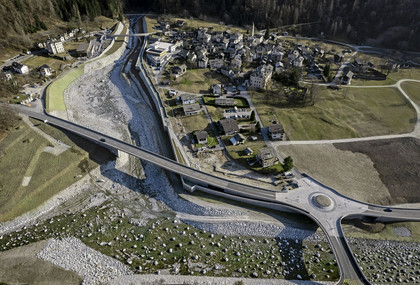
In Bondo (Grisons), authorities have invested 50 million Swiss francs in protective structures, including a dam and a catch basin. In 2017, the village was razed by a mudslide.
But as the country rallies around Blatten, some wonder whether climate change is rendering certain parts of Switzerland uninhabitable. Giving up on Blatten would be unimaginable, says the mayor. “This is our home and our land.” The village belongs to the people who have lost it. “And we have the right to return.” Blatten is a “once-in-a-millennium event” that could happen anywhere. “We would have to relocate the entire country [to avoid every hazard].”
Uncertain future for Brienz-Brinzaul
The spectre of relocation hangs over another Swiss mountain village: Brienz-Brinzaul in Grisons, where unstable slopes were a longstanding issue that came to a head in 2023 (see “Swiss Review” 5/2023). The hamlet’s 90 residents had to evacuate their homes in November 2024. With the threat of a huge landslide literally hanging over it, Brienz-Brinzaul has remained off-limits since then. Rockfalls proliferated again this summer after heavy rainfall, although the situation had become a little less acute by the time of our editorial deadline in mid-August. Brienz-Brinzaul will not be vacated for good, the authorities insist. The construction of a drainage tunnel costing 40 million francs is meant to mitigate the risk of landslides. Nevertheless, the villagers are aware that they may yet have to resettle.
The Bernese Oberland also has its fair share of crumbling mountains. Landslides have been a topic in Guttannen since 2005 (see “Swiss Review” 4/2022), while officials have been closely monitoring Spitzer Stein, an increasingly unstable peak above Kandersteg, for a number of years. Permafrost thaw has weakened one side of Spitzer Stein, raising concerns that millions of cubic metres of rock could come tumbling down and cause flooding. Dams are currently being built to protect Kandersteg. These will cost 11 million francs.
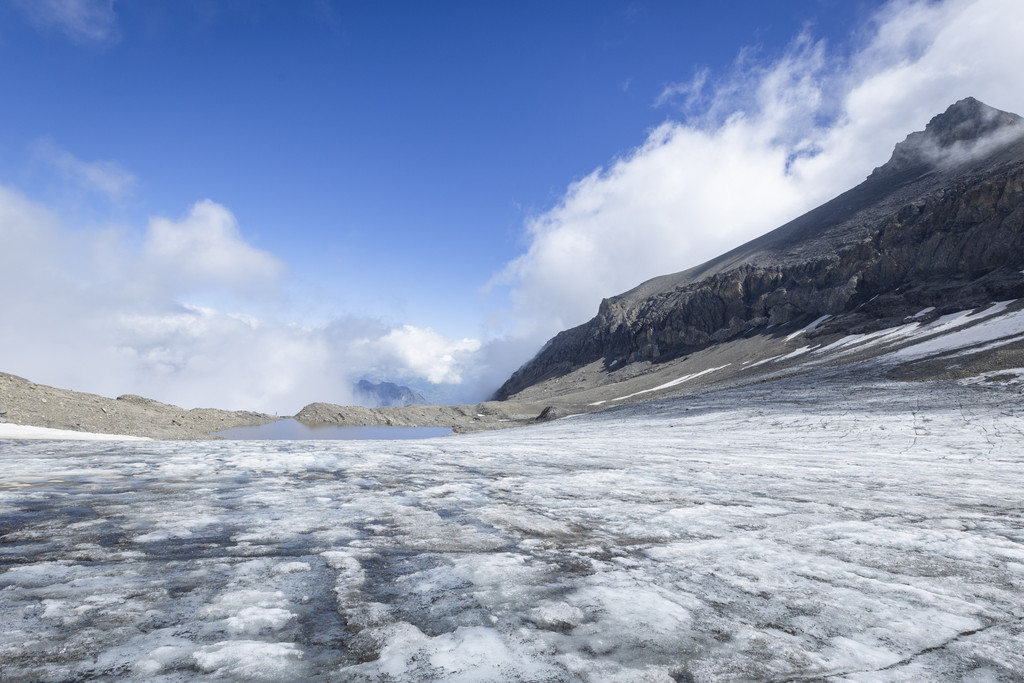
Permafrost, the “glue” that holds mountains together, is thawing at an increasingly rapid pace. Higher temperatures mean more landslides and rockfalls, as meltwater penetrates the permafrost and accelerates erosion.
In general, scientists warn of further deterioration in the Swiss Alps. Permafrost temperatures monitored at over 20 sites by the Swiss Permafrost Monitoring Network (PERMOS) have increased significantly in recent years. Permafrost is commonly found above altitudes of 2,500 metres, acting as the “glue” that holds mountains together. Higher temperatures mean more landslides and rockfalls, as meltwater penetrates the permafrost and accelerates erosion.
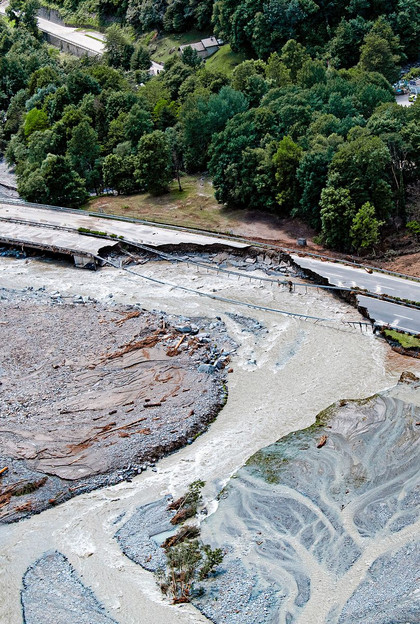
Heavy rainfall in southern Switzerland caused widespread destruction in the summer of 2024. The picture shows a section of the A13 near Lostallo in the Misox Valley that was washed away.
Another growing problem: heavy rainfall
Climate change has also amplified other natural threats. Apart from drought, the Alps have seen a proliferation of heavy rainfall events. Warmer air can hold more moisture. Due to the topography, major concentrated downpours in the mountain valleys can have fatal consequences. A storm in the upper Maggia Valley in Ticino caused flash flooding in summer 2024. Raging torrents obliterated houses, roads and bridges, claiming the lives of eight people. Officials subsequently expanded the area in the valley that it regarded as risk-prone, meaning that a number of houses near water are now classed as unsafe and had to be vacated.
Other cantons are also reviewing their hazard maps and investing a great deal of money in dams to prevent flooding and in netting to intercept rockfalls. In total, Switzerland spends around one billion francs a year on shoring up its defences against natural hazards. This includes investing in early-warning systems that save lives by ensuring that communities are evacuated in time.
ETH climate scientist Sonia Seneviratne, who is vice-chair of Working Group I of the Intergovernmental Panel on Climate Change (IPCC), believes in the importance of prevention. “But these are no more than sticking-plaster measures in the long run,” Seneviratne told the “Watson” news portal in an interview. We need to be asking a different question: “Should we really be living and building more houses in increasingly exposed areas?” Global warming will further increase the risk of rockfalls, landslides and mudslides in the Alps. It is imperative that we take this into account, stressed Seneviratne. “Unless we dramatically cut carbon emissions and get a handle on climate change, future tragedies are almost inevitable.”
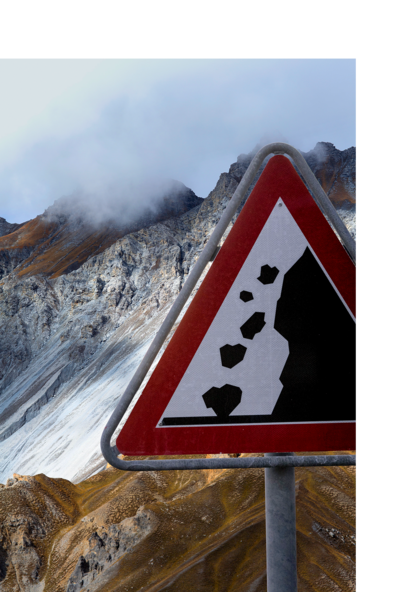
Warning sign in the Swiss Alps. Photo: Keystone (Val dal Botsch)/iStock; montage: Joseph Haas
Thank you for your comment. Your Comment Added Successfully.
Thank you for your comment. Comments are approved within one to three days.
Oops! Something went wrong, please try again later.
Comments :
Thank you for your comment. Your Comment Added Successfully.
Christina Hoffmann, Dänemark 08.10.2025 At 17:52
Die Schweizer sind selber schuld. Die idiotischen Windmühlen überall, die grūne Ideologie von Wärmepumpen und E-Auto... Ihr macht euch doch selber alles kaputt. Die Natur rächt sich.
Show Translation
Thank you for your comment. Your Comment Added Successfully.
Regula Maltry, Dänemark 08.10.2025 At 15:57
Was macht man in der Schweiz gegen Naturkatastophen und wie verhindert man sie? Hat man genug Geld, um Katastrophen zu verhindern? Sollte EU mit Ökonomie beitragen?






Comments
Comments :
Die Schweizer sind selber schuld. Die idiotischen Windmühlen überall, die grūne Ideologie von Wärmepumpen und E-Auto... Ihr macht euch doch selber alles kaputt. Die Natur rächt sich.
Was macht man in der Schweiz gegen Naturkatastophen und wie verhindert man sie? Hat man genug Geld, um Katastrophen zu verhindern? Sollte EU mit Ökonomie beitragen?