Switzerland and the war in Ukraine
06.02.2026 – Christof Forster
Four years on, and the war in Ukraine continues to have an impact in Switzerland. Amid fierce debate over increased defence spending and the question of neutrality, the armed forces are enjoying renewed public support, while the flow of refugees from the war zone has stiffened Switzerland’s asylum stance.
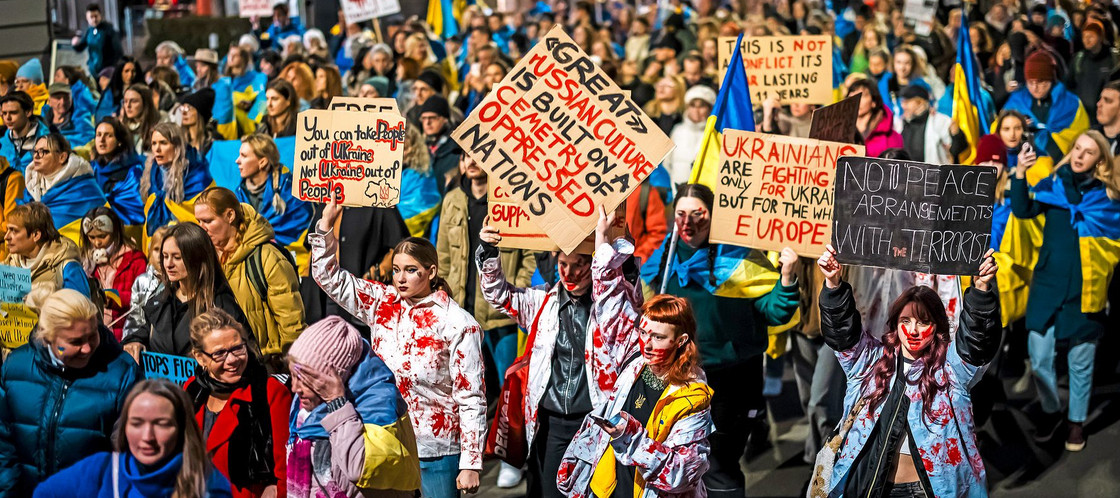
The Federal Council lifted the last Covid restrictions in mid-February 2022 – only to face a new problem one week later. Nonetheless the government found it hard to flick the crisis switch back on immediately. In front of the media, the President of the Swiss Confederation Ignazio Cassis called Russia’s invasion of Ukraine a “sad day” and made vague reference to sanctions. The government appeared before the cameras one day later, now as a group of three, but once more it was still unclear where the Federal Council stood. Everyone had seen the shocking footage from Ukraine by then. Protests against the invasion drew crowds around the country.
People in Europe had got used to peace after the Cold War and, again, after the Balkan wars of the 1990s. There has been fighting in eastern Ukraine since 2014. But it was not until the full-scale invasion and the battle for Kyiv that the conflict properly hit home in Switzerland. The tangible consequences came in the form of a wave of refugees from Ukraine. Cars with “UA” registration plates soon became a common sight around Switzerland. Meanwhile, demand for Ukrainian flags surged. People stood with Ukraine. Defence spending increased. And parliament debated whether soldiers should again be allowed to keep ammunition at home – this, too, a consequence of Europe’s security landscape being reshaped by the war.
The great neutrality debate
By adopting European Union sanctions against Russia, the Federal Council sparked a fierce debate around Swiss neutrality that rumbles on to this day. Former Federal Councillor Christoph Blocher (SVP) wasted little time in announcing a popular initiative. He described economic sanctions as a “weapon of war”. Playing into the hands of an aggressor is not being neutral, Cassis countered. Blocher’s initiative advocates a strict interpretation of neutrality. Switzerland should no longer be able to impose sanctions on warring countries – United Nations sanctions constituting the sole exception, says Blocher.
So how has the war in Ukraine changed Swiss attitudes to neutrality and the armed forces? According to an annual study by ETH Zurich that evaluates public opinion on foreign, security and defence policy issues, overwhelming public support for neutrality remains intact – with some 90 percent of respondents still in favour. Yet 28 percent say that Switzerland should also make its position clear in relation to military conflicts, despite its status as a neutral country. This view is much more popular since the war began, compared to the years that preceded hostilities. Seventy per cent also think it right that Switzerland adopt sanctions against Russia.
Hubert Annen has been lecturing in military psychology at the ETH Zurich Military Academy for about 30 years. His professional activities had for a long time engendered responses in his private circle ranging from scepticism to outright disapproval, he says. He often found himself having to explain – or even justify – his work. This changed after Putin’s invasion. “Most people now agree that Switzerland needs an army, not to mention experts looking after the mental health of our soldiers.”
ETH Zurich has also assessed the impact of war on public sentiment. Wars and conflicts are now seen as the biggest threat. Never in the past 35 years have so many voters felt that Switzerland is underspending on defence, while 82 per cent of those surveyed believe that the army is necessary – a marked increase. And something else has changed: as in previous conflicts, more people now want Switzerland to move closer to NATO, with the ETH Zurich study indicating a narrow majority in favour of Swiss-NATO rapprochement.
The armed forces are now a little more popular than they were. Yet the public have less of an appetite to pick up the tab, says Annen. The vast majority of respondents say that they are unwilling to fund defence spending through higher taxes or any other additional commitment.
Criticism from abroad
Foreign pressure on Switzerland and the Federal Council mainly comes from European nations that wish to re-export their Swiss-made munitions to Ukraine but are prevented from doing so by the Federal Council. The countries in question criticise the strict interpretation of neutrality in this case and have threatened to stop buying from Swiss arms manufacturers. Berne has now responded, with the Swiss parliament voting in December to relax restrictions on arms exports that were introduced shortly before the invasion of Ukraine.
Peace activist and former Green National Councillor Jo Lang calls the decision a smokescreen. Delivering munitions via third-party countries, he says, is legally unfeasible and militarily of little significance. “Switzerland should instead think about how its commodity traders have filled Putin’s war chest and how Swiss manufacturing has contributed to Russia’s war machine.” Given that a lot of Swiss money and key materials are fuelling Russian aggression, Switzerland has a particular obligation to help Ukraine financially, he adds. However, relative to its economic strength, Switzerland has been one of the least generous European countries until now.
Conservative politicians, for their part, called for higher defence spending in the wake of the Russian invasion. And their wishes have since been granted, with parliament increasing the defence budget and cutting foreign aid. The left-wing parties have accused the conservatives of military tub-thumping.
The defence ministry now wants to increase VAT in order to cover the billions of francs in additional spending, according to reports in the media. The armed forces are set to receive a lot more money in the long term – again as a consequence of the war in Ukraine.
Successful integration
Beyond politics, the Swiss public has shown solidarity and support towards Ukrainian refugees, helping them with German tuition, administrative procedures, and the search for accommodation. In the first three months after the invasion, 80 per cent of Ukrainian refugees in Switzerland stayed with private hosts. Looking back, Miriam Behrens, the director of the non-governmental Swiss Refugee Council, says that Switzerland coped well with the influx, which saw the number of asylum seekers skyrocket from 20,000 to 100,000. The asylum system is stable but has reached its limit, she adds. As an example, Behrens notes that public officials have voiced criticisms that have then been picked up by politicians and dominated public debate. “This has paved the way for a lot of new restrictions, not only affecting protection status S but also the asylum system per se.” Refugees seem to be an easy target, she complains.
Yet Behrens believes Switzerland can be proud that 45 per cent of people who arrived in 2022 are currently in work. Our country should take a great deal of credit for this, she says. Although the war in Ukraine has left its mark on Switzerland, Ukrainians themselves have largely melted into everyday life.
Read our lead article on Ukraine, published in July 2022:
Refugees welcome


![[Translate to English:]](/fileadmin/_processed_/c/d/csm_283259_b411da83c0.jpg)

Comments
Comments :
Les mesures prisent par les gouvernements australiens et français vont dans le bon sens. J'approuve pleinement l'interdiction des smarphones dans les établissements scolaires.