Metalchurch | The heavy metal church
24.04.2026 – Susanne Wenger
Services of worship at the social club, pastoral care at music festivals, Bible classes over beer. At the beginning of 2026, the Metalchurch became Switzerland’s first-ever recognised congregation based on a specific style of music. Facing decline, Switzerland’s official churches are looking at ways to reinvent themselves.
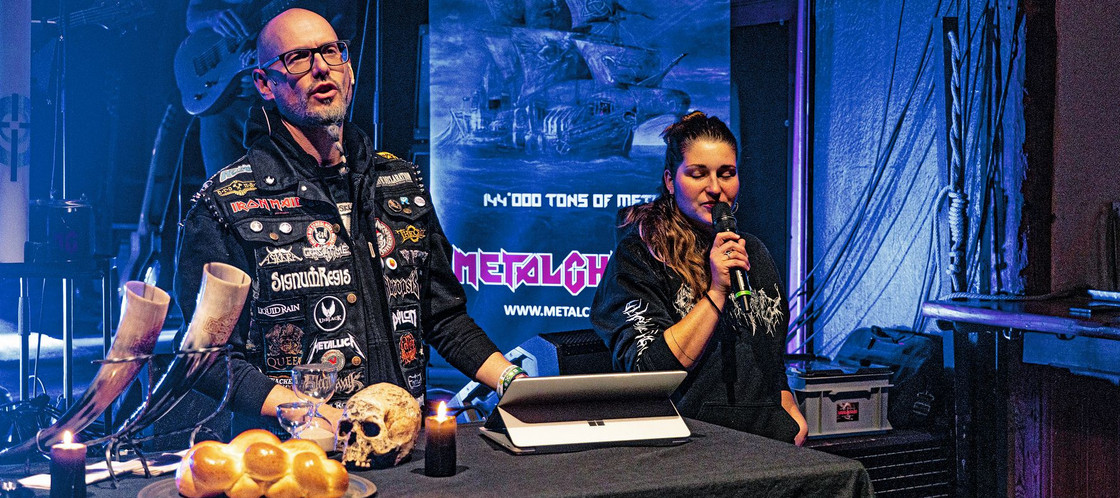
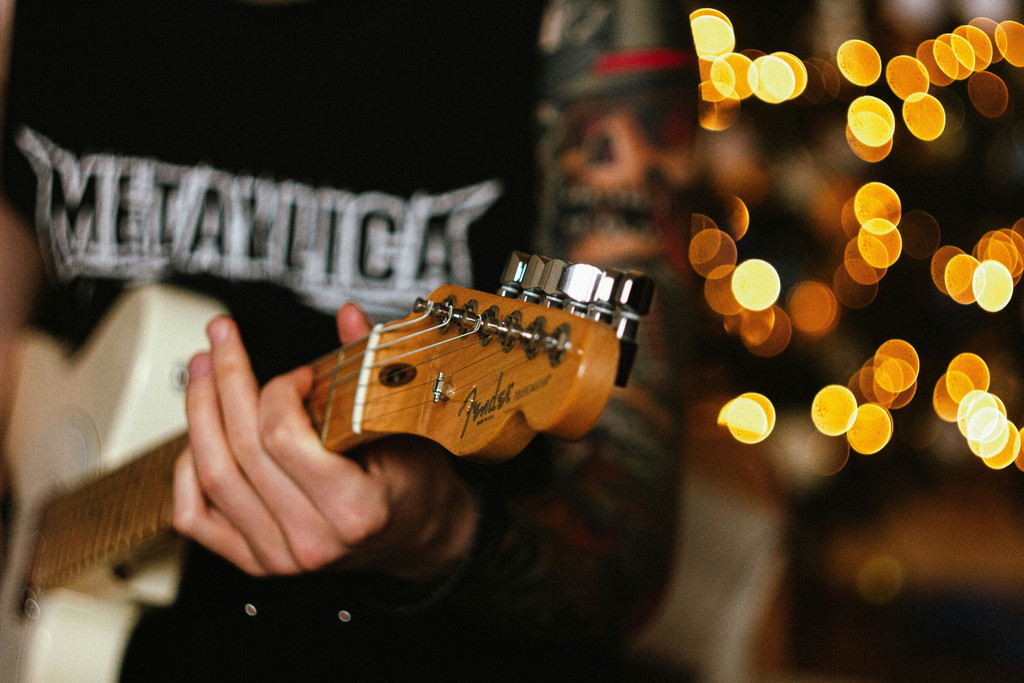
Metalchurch pastor Samuel Hug talks to us in his little office in Kirchberg near Berne, not far from the Protestant Reformed church that has dominated the village landscape for more than 500 years – although Switzerland’s most recently formed congregation has no church building of its own. “It keeps us on our toes,” he says. Hug’s black hoodie has a band logo. Music flyers hang on the wall, next to shelves containing books on heavy metal as well as hundreds of CDs. Physical audio formats are popular among metal fans. When writing his sermons, Hug listens to heavy metal and looks for ways to connect this music with the gospel. “I always find something.”
Hug, an ordained minister in the Reformed Church, is married and has four sons. He used to serve two rural parishes in Berne, the canton with the most Reformed Church members. After the Catholic Church, the Protestant Reformed Church is Switzerland’s biggest religious denomination. Hug discovered heavy metal as a teenager in eastern Switzerland – despite warnings that this was “the devil’s music”. He fell in love with its powerful, rebellious sound. Metal legends Judas Priest, who hail from Birmingham in the UK, remain one of his favourite bands.
Hug and other like-minded individuals founded Metalchurch in 2012 – firstly as a side venture, all of their own accord. “We wanted to build a bridge between the church and the metal scene,” he explains. But this took time. Hug and his friends had to win over both sides: metal fans who were sceptical, as it were, of joining the flock, and, on the other hand, members of the congregation who felt uneasy about the Protestant Reformed Church being associated with such a project.
Recognition
Following years of – in Hug’s words – “both sides getting to know each other”, the Berne-Jura-Solothurn Reformed Churches appointed Hug as their full-time “pastor of innovation” in 2022. In November 2025, the Synod – the secular church parliament – officially recognised the Metalchurch with only one opposing vote, promising it 180,000 Swiss francs in annual funding along with Hug’s salary. The reason it gave was that the Metalchurch attracts people who would otherwise barely have any connection to the church. The Metalchurch operates within the broad spectrum of a mainstream church, says Berne-Jura-Solothurn media relations officer Markus Dütschler, adding that the Metalchurch has steadily found its footing and grown since being founded. The Synod can see that it offers people a spiritual home.
This is a remarkable first in Swiss ecclesiastical history. Switzerland’s three officially recognised churches – Roman Catholic, Protestant Reformed, and Christian Catholic – have traditionally been run along regional lines. Instead of being organised around people’s place of residence, Hug’s is the first church to be geared to a specific group of people. Unlike local parishes, it cannot collect taxes from its members, hence it receives money directly from the cantonal church. Donations still account for a proportion of its funding.
Why heavy metal?
That the church’s theme is heavy metal – a sub-culture of screeching riffs, made famous by “Prince of Darkness” Ozzy Osbourne – is something that Hug considers not miraculous but entirely logical. “Metal covers the big themes in life,” he says. Like the Bible itself, it does not shy away from things like pain, doubt and the depths of human existence. It shares the same Christian message of hope, he adds. The only difference is the way in which this message is delivered. “What unites us is faith.”
“Churches cannot afford to wait for people to come to them. They must go to where the people are.”
Samuel Hug
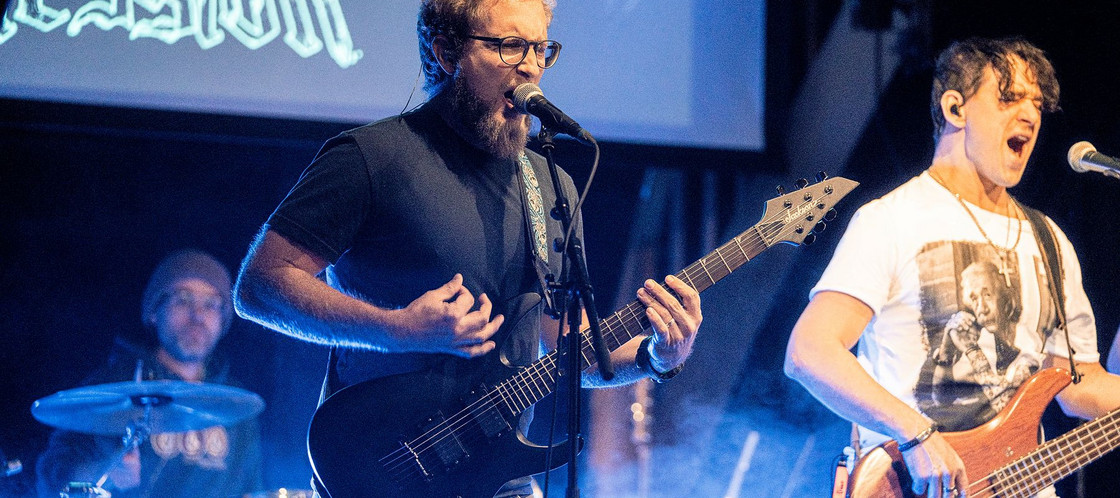
A social deaconess works with Hug in an employed role as part of an eight-person leadership team, while 125 volunteers provide support – twice as many as four years ago. There is no membership list: it is a fluid congregation that gathers wherever it sees fit. Over 100 people attend the Metalchurch’s monthly services of worship, which feature live music, take place at a social club and are broadcast on an online radio channel called “Drachenblut” (dragon blood). The Metalchurch also provides pastoral care at music festivals – it clocked up nearly 30 such events last year – and hosts discussions like Bible, Beer & Metal in people’s living rooms. Metal-themed baptisms, weddings and funerals are less in demand. This reflects the decline in traditional rituals, says Hug.
A shrinking flock
The Metalchurch has been recognised at a time when Switzerland’s religious landscape is in a state of flux. For decades, the once dominant official churches have been losing members. Federal statistics show that 47 per cent of the population belonged to the Roman Catholic Church in 1980. Now the figure is 30 per cent. Protestant Reformed Church membership fell even further, from 45 to 19 per cent. Religious diversity grew in the same period due to migration. But most notably, the number of people with no religious affiliation increased, making up the biggest share of the population in 2024 – the first time this has happened – at nearly 37 per cent compared to only around four per cent in 1980.
The haemorrhaging mainstream churches are consequently losing income. Parishes have merged and sold their building stock, including churches. The consensus in some quarters – and not only in increasingly secular Switzerland – is that fresh ways to spread the gospel are needed to stop the rot. Churches should “contextualise” their message more, i.e. adapt it to real life, they say. Conventional and alternative congregations, e.g. forest churches, have existed on an equal footing in the Church of England since 2008. Such approaches remain nascent in Switzerland, where the cantonal churches make their own decisions.
Antidote to the church malaise?
“We want to embrace new expressions of worship,” says Markus Dütschler. Berne-Jura-Solothurn have a dedicated innovation fund to promote over 30 projects, ranging from a hip-hop centre and a queer parish office, to an urban monastery located in a repurposed set of church buildings. Recognising the Metalchurch as an official congregation is the most significant step taken by a cantonal church to date. Whether more dedicated communities follow remains to be seen. Metal fan Hug, a decidedly proactive minister of the cloth who is smart at getting his message across, already has the answer: “Churches cannot afford to wait for people to come to them. They must go to where the people are.”
www.metalchurch.ch



![[Translate to English:]](/fileadmin/_processed_/c/d/csm_283259_b411da83c0.jpg)

Comments
Comments :
Impressionnee et ravie de voir cette ouverture sur les autres. Un rapprochement qui nous montre un des chemins vers la paix. Dans la différence il y a toujours une possibilité de s'unir dans le respect de chacun.
Was die Massen allgemein in die Arme einer Religion treibt, ist die Suche nach einer Antwort auf die Frage der Angst vor dem Dasein. Dazu gehört aber nicht wenig an Symbolik und Ritual, und Letztere, meine ich, fehlen der protestantischen Kirche um heute noch massenaktraktiv zu sein - insbesondere zur heutigen Zeit, wo jede zweite konspirative Digitalplattform mehr an "Religion" anbietet. Ob METAL dieses protestantische Ritualdefizit ausgleichen kann? Ob dies genug ist, um die momentane Erlebnisbegeisterung der Massen auch das religiöse stille und langfristige Insichgehen zu aktivieren?
If this is a movement that is dedicated to preaching the true and undefiled gospel, this is or will be evangelism to save lost sinners for eternity—by the salt that didn’t loose its strength.