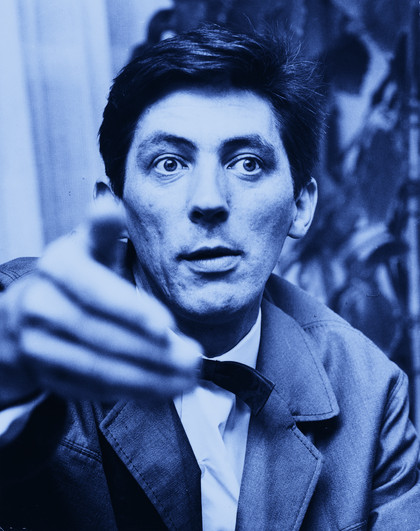
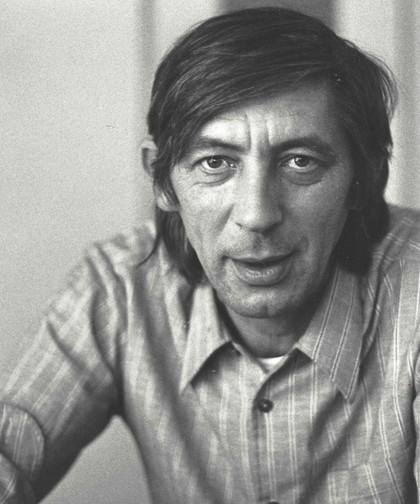
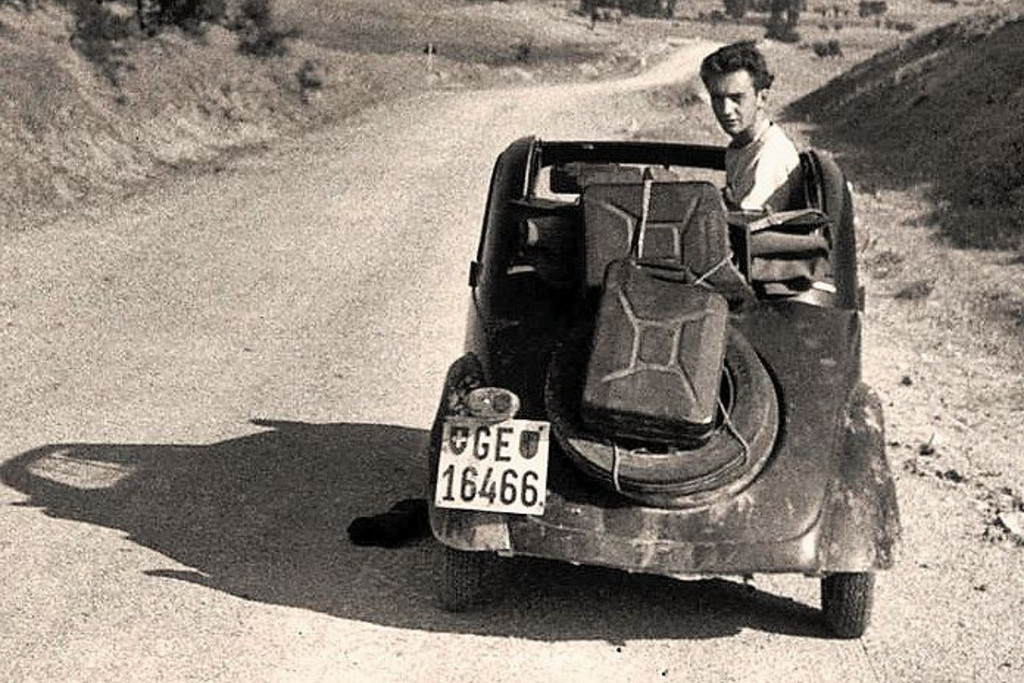
Walter Matthias Diggelmann was born on 5 July 1927 in a mother-and-baby home, grew up in Grisons and fled to Italy at the age of 17 after engaging in petty theft. There he was arrested and sent to Germany, where he experienced bombs, prison and terror. He returned to Switzerland with his tail between his legs, resolving thereafter to make something of his life. Emerging from this hopeless situation, Diggelmann was one of the few of his generation with the courage to turn the accepted view of Switzerland on its head.
A bona fide author
“The stories you tell, and the way you tell them, prove that you are a wordsmith,” proffered a student to whom Diggelmann recounted his experiences in 1947. Without further ado Diggelmann ensured that “writer” was added to his identity card. Diggelmann had written 17 unpublished novels by 1954, often receiving support from the writers’ guild. Only then, by that time employed at Dübendorf military airfield, did he find a publisher for his aviation novel “Mit F 51 überfällig”. “I am a civil servant at Dübendorf,” he proudly told the author Erwin Heimann, “who is writing more and better than ever, is happily married, and can do without any support.” But this prosaic contentment did not last long. Diggelmann’s faith in Swiss society was shaken to the core when, in 1959, working as a copywriter for PR agency Farner, he learned how easy it was to manipulate public opinion.
“I am not the one in this novel, it is the world I love that is contained in it, in every word and in every utterance. I committed grave sins for it and went through no little suffering to experience this purification. Some people will be shocked. Yet by no means is it nihilism that I preach, but faith – the simple faith that comes from heaven and leads back there, beyond any form of legislation.”
Diggelmann, 1951, in a letter about his unpublished novel “Sohn ohne Vater”.
He condemned Switzerland’s asylum system
“Das Verhör des Harry Wind”, the novel with which Diggelmann made his breakthrough, uncovered the machinations at Farner in 1962. “Die Hinterlassenschaft”, the 1965 book in which Diggelmann denounced Switzerland’s asylum system in the years 1933 to 1945, was likewise based on material from his time as a copywriter. The novel itself was not particularly successful, and its attempt to equate the anti-Semitism of the war years with the anti-communism of 1956 went down like a lead balloon. Diggelmann also made the mistake of allowing changes to the book’s East German edition in order to placate the communist regime in East Berlin. He was called a traitor. In 1973, this culminated in what Reni Mertens and Walter Marti dubbed “The self-destruction of Walter Matthias Diggelmann” in their film profile of the same name.






Comments