Remembering cabaret artist and dramatist Elsie Attenhofer (1909–99).
[Translate to English:] Elsie Attenhofer (1909–1999)
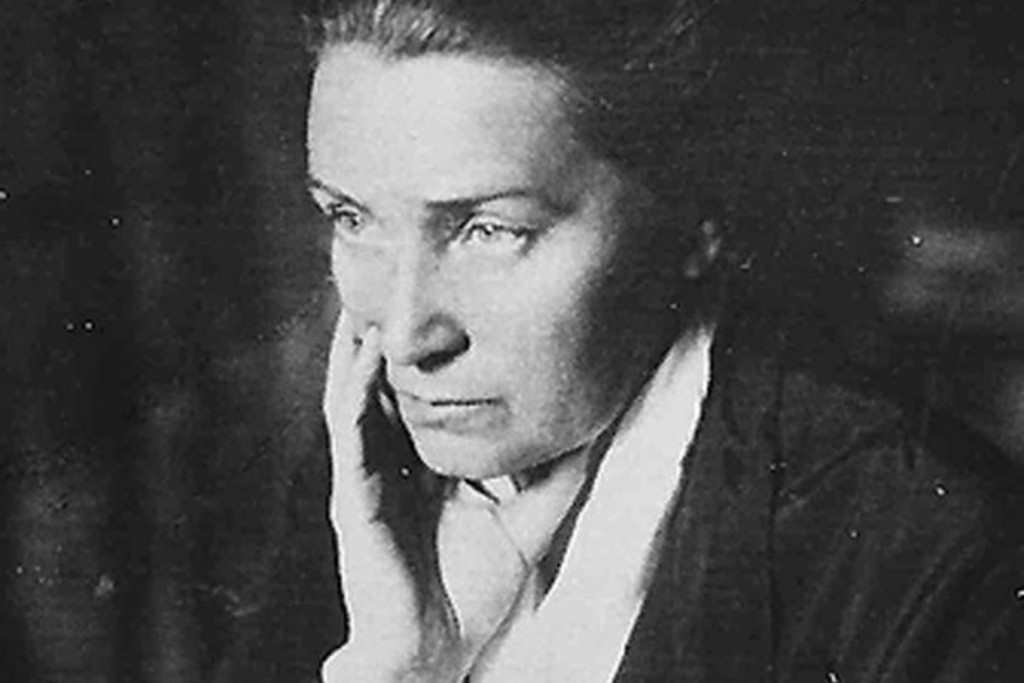
The 1934 autumn programme of legendary Swiss cabaret company Cabaret Cornichon featured 25-year-old Elsie Attenhofer from Zurich debuting with the song “Das alkoholfreie Mädchen” (The alcohol-free girl). Attenhofer remained a firm fixture with Cabaret Cornichon until 1942, doing many other successful turns. Originally a qualified medical secretary and one of the first women in Switzerland to obtain a pilot’s licence, she learned the art of singing and reciting from Max Werner Lenz and became one of the best-loved cabaret artists of her generation long after her time at Cornichon had ended.
From cabaret to film
Attenhofer also took on roles in movies such as “Die missbrauchten Liebesbriefe” (The misused love letters, 1940) and “Füsilier Wipf” (Fusilier Wipf, 1938), which was associated with the spiritual defence of the nation on the eve of the Second World War. She met her future husband – the philologist Karl Schmid, who was later appointed professor at ETH Zurich – while shooting the latter film. After marrying Schmid, Attenhofer retired from the stage to start a family. This was until she read a newspaper report in 1942 about the Nazi round-up of Jews in Paris. Outraged, she decided to write a play on anti-Semitism. She was expecting her second child at the time.
“Here is a woman whose intelligence, charm, human warmth and ‘je ne sais quoi’ fills the stage. She has an irresistible attraction and is blessed with remarkable versatility. A few adjustments here, a few flicks of the hand there – and she transforms into yet another completely different person with their own unique appearance, gait, gestures and language.”
“Neue Zürcher Zeitung”, 5 November 1952, describing one of Elsie Attenhofer’s solo performances.
“Who will cast the first stone?”
Yet the play, originally entitled “Anno 1943”, was not set in Paris but in a Swiss living room, with the dialogue in Swiss German. And Attenhofer openly posed the question that few had dared to ask: how complicit are we? Yet no theatre had the courage to host the play. Schauspielhaus Zürich rejected it outright. Kurt Horwitz tried, and failed, to show the play in Basel. “Wer wirft den ersten Stein?” (Who will cast the first stone?) finally debuted on 11 October 1944 at Basel’s Küchlin Theatre. It was produced by the Theater- und Tournee-Genossenschaft Zürich and directed by Max Werner Lenz.
Cabaret artist Elsie Attenhofer in her role as “Fräulein Vögeli” takes the microphone, recorded on 26 February 1944. Photo: Keystone
Thousands in Switzerland saw the play
The play was performed over 60 times to a full house in Basel – and at least another 60 times in numerous towns and villages across Switzerland. Theatregoers in Lausanne even saw a French version in 1945. But what suddenly became a tour de force would soon be forgotten. Attenhofer herself remained famous until her death on 16 September 1999 – not because of her work as a dramatist but on account of her acerbic and amusing solo performances. It was not without reason that she was regarded as Switzerland’s “grand old lady” of cabaret. Nevertheless, “Wer wirft den ersten Stein?” was included in an anthology of forgotten Swiss theatre productions that was published in 1993 by Ursula Käser and the recently deceased Basel philologist Martin Stern. Although very much of its time, “Wer wirft den ersten Stein?” was imbued with a unique character that sets Elsie Attenhofer apart from most other Swiss writers of her era.
Touching homage
The most beautiful homage paid to Elsie Attenhofer, one of the most fearless wartime dramatists, during her lifetime was in a letter written to her by the Swiss-based Hungarian émigré and actor Lukas Stern following a performance in 1944. “I have had so many disappointments, so I want to thank you now for restoring my faith in humanity,” he declared. “I want to thank you for your courage in genuflecting to so many people like me across Europe. If you could simply use your imagination without actually having lived through any of the horrors, what were all the other European artists, poets and writers doing? Why did so few of them use their talent to stand up for us?”
Bibliography: “Wer wirft den ersten Stein?” is included in “Kein einig Volk: fünf schweizerische Zeitstücke, 1933-1945” – an anthology published by Ursula Käser-Leisibach and Martin Stern; Haupt Verlag, Berne 1993.
Charles Linsmayer is a literary scholar and journalist based in Zurich








Comments