Funding for the Swiss Broadcasting Corporation (SRG SSR) will not be slashed by nearly half, after voters and cantons rejected the “CHF 200 is enough” initiative at the ballot box on 8 March. The public broadcaster still has to cut costs. But how?
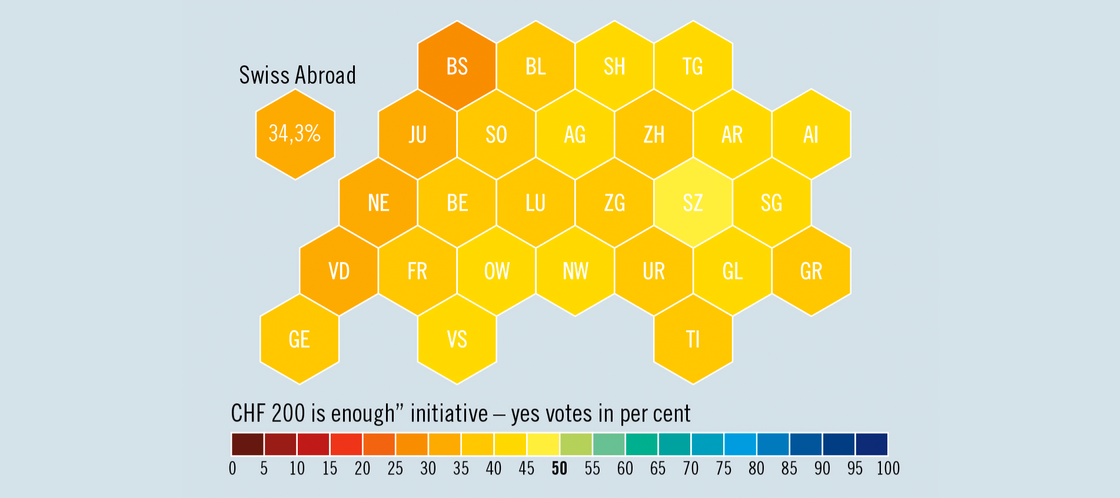
The “CHF 200 is enough” initiative was one of five proposals on a busy voting Sunday. On all issues – public broadcaster; tax system; cash; climate action – voters followed the recommendations of the government and parliament (see visual data). Turnout was higher than usual, at over 55 per cent. In particular, “CHF 200 is enough” drove people to the polls. A right-wing campaign led by the Swiss People’s Party (SVP) had wanted to cut the annual Swiss television and radio licence fee from 335 to 200 Swiss francs per household and exempt companies from the levy entirely. SRG SSR, which broadcasts in all four language regions and produces content for the “Fifth Switzerland”, would have seen its budget nearly halved (see “Swiss Review” 1/2026). However, 61.9 per cent of voters rejected the plan. None of the cantons voted yes. The expatriate no was even clearer than the national average, at 65.8 per cent. SRG SSR Director General Susanne Wille called the result a “firm vote of confidence”. Voters had already lent the public broadcaster their support in 2018, when a thumping majority rejected an initiative to abolish the licence fee.
Cost-cutting remains imperative
But the director general cannot rest on her laurels, as SRG SSR has to save around 270 million francs, or 17 per cent of its budget, by 2029. This is because Wille still has to contend with a drop in the licence fee along with dwindling advertising revenue: even before the March 2026 vote, the federal government had opted to reduce the licence fee gradually to 300 francs from 2027 onwards and make more companies exempt. SRG SSR will, therefore, make less money despite the vote, but not to the extent originally feared. This is the “alternative outcome”, said one of the parliamentarians who championed the initiative, government minister Albert Rösti (SVP), whose portfolio covers the media.
How to interpret the result of the vote is already a point of contention, because the SRG SSR broadcasting licence expires in 2028 – a remit that the Federal Council regularly renews as required by the constitution and the law. Rösti has already stated that, from 2029, SRG SSR is to focus more on information, culture and education and less on sport and entertainment.
Anger in the no camp
This has enraged opponents of the initiative, who say that people voted for a broad-based SRG SSR providing a full range of content. It is also worth noting that the SRG SSR digital offer will be a factor in the next licence agreement. Private-sector media groups insist that SRG SSR should not crowd out the online content of commercial providers. The government makes decisions on the broadcasting licence, but political parties, interest groups and other organisations will be able to submit their views during a consultation process in 2027.
The extent to which cost-cutting will affect the public broadcaster’s international content and the ten-language swissinfo platform in particular is still unclear. Although parliament has already had its own say: the Council of States voted in winter to maintain state funding of international content; the National Council did likewise this spring. The government had wanted to cancel the subsidy as part of its federal budget relief package. International content is funded on a fifty-fifty basis by the state and the licence fee. Half of this money is now ring-fenced, thanks to parliament’s decision.
Basel suspends e-voting after glitch
The canton of Basel-Stadt was unable to check any online votes on Sunday 8 March due to technical problems affecting the USB sticks that are needed for decryption. This meant that 2,048 votes from Swiss Abroad and from voters with physical or mental impairments remained uncounted. At the time of our editorial deadline, it was unclear whether the online votes would be counted in time for the official confirmation of the voting results by the federal government later in March. There was no tangible effect on the overall results, given that none of the votes were tight. Nevertheless, this annoying glitch has consequences.
The Basel-Stadt cantonal government has suspended its e-voting pilot until the end of 2026 and ordered an external inquiry. There were even suggestions of foul play a few days after the vote. Public prosecutors have launched an investigation into possible fraud. The authorities asserted that the glitch had nothing to do with the e-voting system as such. Nevertheless, critics of online voting felt vindicated. Four cantons are currently piloting e-voting: Basel-Stadt, St Gallen, Thurgau and Grisons.
No to the “CHF 200 is enough” initiative
Only 38.1 per cent of the electorate voted yes to halving the SRG SSR licence fee. The proposal from the SVP and the Swiss Trade Association was similarly rejected by all the cantons. The narrowest result was in the canton of Schwyz. Swiss Abroad were even less in favour.
Cash in the constitution – yes to counterproposal
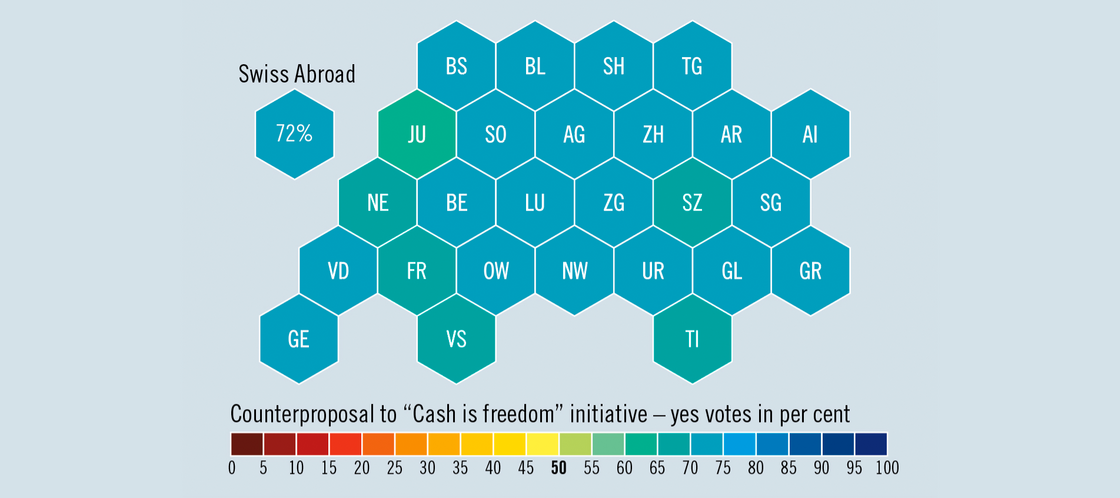
Cash (see “Swiss Review” 5/2025) is now enshrined in the constitution, but not to the extent proposed by the “Cash is freedom” initiative, which was rejected. The more moderate counterproposal by the Federal Council and parliament attracted wide support, as the map shows. Some 73.4 per cent were in favour; the percentage of yes votes in the “Fifth Switzerland” was slightly lower.
No to the Climate Fund Initiative
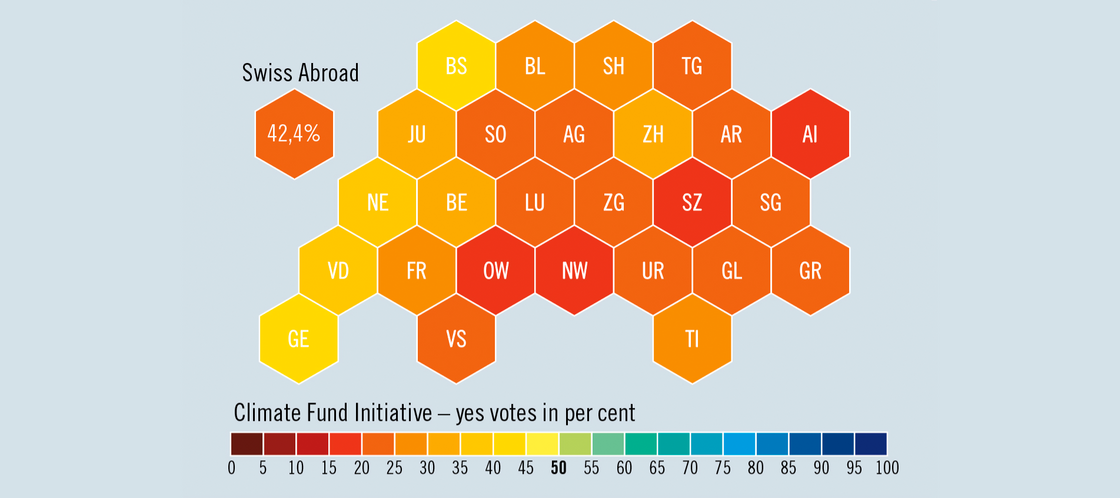
Free up billions of francs for a fund on climate action (see “Swiss Review” 1/2026)? The electorate rejected this idea from the Greens and the SP, with 70.7 per cent voting no. Swiss Abroad were more receptive to the proposal but also voted no. Compared to the other votes, the issue barely attracted any public debate.
Yes to individual taxation
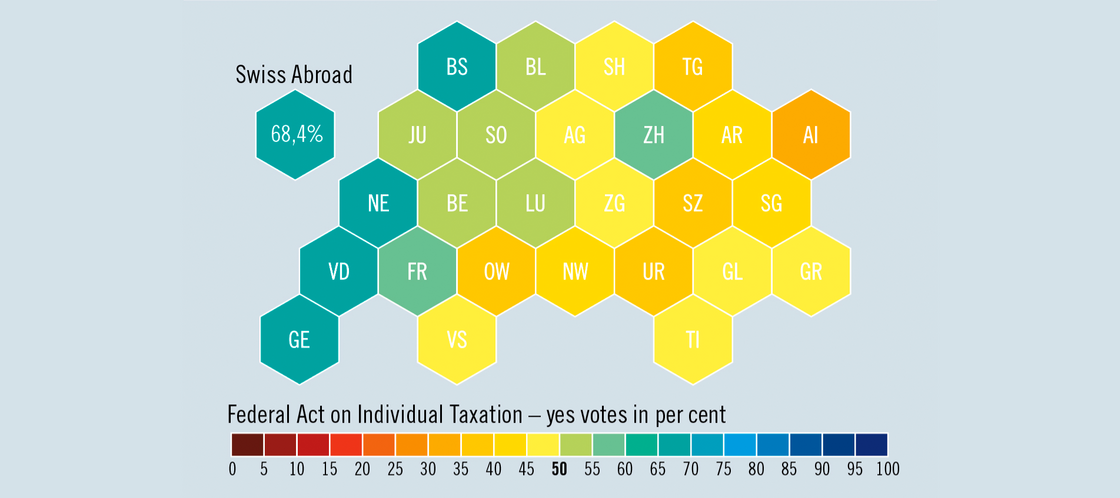
The electorate approved a change in tax law, with 54.3 per cent voting yes. Every person will now be taxed individually, regardless of their marital status. The expatriate yes was even more emphatic. This marks the end of the so-called “marriage penalty” – which some cantons had wanted to maintain by calling a referendum in the first place. The Confederation and cantons must implement the reform by 2032.














Comments