Menu
stage img
  • Politics

The left wants billions in climate investment

06.02.2026 – Eveline Rutz

Should Switzerland invest more to deliver on its climate goals? Yes, according to the Climate Fund Initiative tabled by the SP and the Greens. Opponents say the proposal risks saddling future generations with debt.

Recent climate forecasts are alarming enough. Now the SP and the Greens have doubled down, reiterating that temperatures in Switzerland are rising twice as fast as the global average. Without rigorous climate action, the country could face temperature increases of up to 4.9°C by the end of the century. “Heatwaves, drought and torrential rain are becoming more common and threaten both our health and our infrastructure,” says SP co-chair Mattea Meyer. To address the climate crisis – “one of the biggest challenges of our time” – effectively, the left want the state to do more. Essentially, they are proposing the creation of a fund that would be replenished with annual contributions of 0.5 to one per cent of GDP. Their popular initiative – “For a fair energy and climate policy: Investing for prosperity, jobs and the environment (Climate Fund Initiative)” – will be put to the electorate on 8 March 2026.

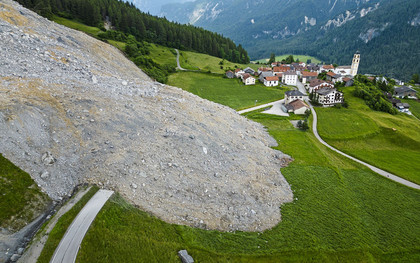
The glacial collapse and resultant landslide that obliterated Blatten. Events like this have upped the political ante. Climate change is an established reality in Switzerland, say supporters of the initiative. The consequences are now more dramatic than ever. Photo: Keystone

“We will make Switzerland carbon-neutral,” promise the authors of the initiative, which they say will free up 3.9 to 7.7 billion Swiss francs of federal money every year for insulating buildings, supporting the shift to electric vehicles and driving the expansion of solar power among other things. The funds would help to promote biodiversity and cover the cost of retraining programmes designed to ensure that enough workers have the necessary skills for jobs in a low-carbon economy. Essentially, the initiative would play a part in reducing greenhouse gas emissions to net zero by 2050 – an objective approved by voters in 2023. And Switzerland would have more autonomy. “A climate fund will strengthen our energy security, because we will finally wean ourselves off foreign oil and gas,” says Lisa Mazzone, President of the Greens.

The evacuated village of Brienz/Brinzauls – crumbling mountains epitomise the increasing real-life threat posed by climate change. Photo: Keystone

Critics warn of financial risks

But the Federal Council and a majority in parliament see things differently. Their argument is that existing climate policies “combining targeted funding, legislation, and economic instruments” will deliver the desired reduction in CO2. Policies that are focused and establish effective incentives without the need for broad-based subsidies – or further funding. The Confederation and cantons currently spend around two billion francs a year on energy and climate measures, with 600 million francs set aside for promoting biodiversity.

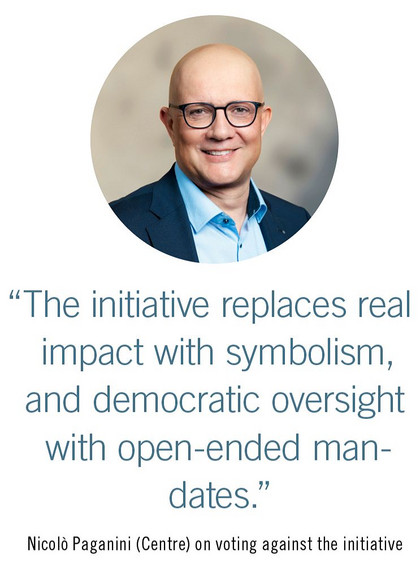
Opponents of the initiative warn against putting additional strain on the federal coffers when money is already tight. They complain that the proposed expenditure would not be subject to the mechanisms designed to curb government debt. “This would mean saddling future generations with a mountain of debt,” says National Councillor Andri Silberschmidt (FDP). It would be the opposite of sustainable. Silberschmidt warns of inefficiencies that would see subsidies often going to projects that would have been undertaken anyway. Take oil-fired heaters, for example – these now tend to be replaced by heat pumps. Rarely do state subsidies bring about fundamental changes in behaviour, he argues. National Councillor Nicolò Paganini (Centre): “The initiative replaces real impact with symbolism, fiscal discipline with autopilot, and democratic oversight with open-ended mandates.”

The state “must step up”

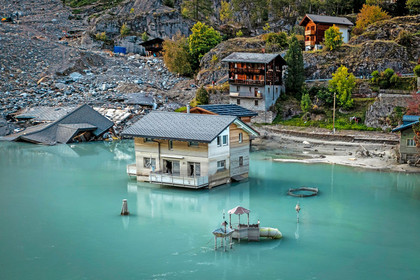
Climate change is an established reality in Switzerland, say the authors of the initiative, citing the natural disasters in Gondo (Valais), Ticino, Brienz/Brinzauls (Grisons), and, most recently, Blatten (Valais). “We humans are the ones who will suffer,” proffers Katharina Prelicz-Huber of the Greens. Nature will get by somehow, but people will lose their livelihoods – and their lives.

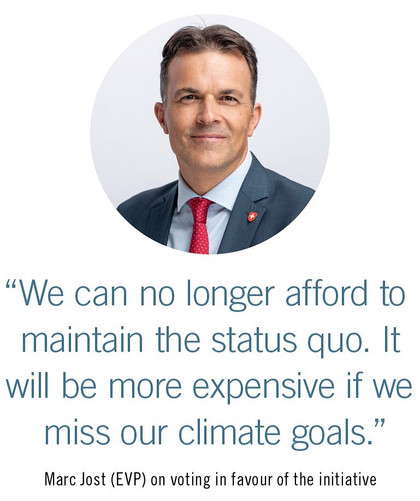
SP National Councillor Gabriela Suter believes the state must step up and invest in protecting the interests of future generations: “Only through foresighted measures can we ensure a bright future for our descendants.” Marc Jost of the EVP agrees. Switzerland is not doing enough to become carbon-neutral and meet its international obligations, he says. “We can no longer afford to maintain the status quo.” It is important for the state to avoid taking on additional debt, but it will be more expensive if we miss our climate goals, he says. If voters approve the initiative, the new climate fund will be available from 2029.

Bund und Kantone geben heute pro Jahr rund zwei Milliarden Franken für den Klimaschutz aus. Mit dem Klimafonds kämen gleich mehrere Milliarden dazu.

Overview of the federal votes on 8 March 2026

Future-proofing the availability of cash
The “Cash is freedom” initiative requires the federal government to ensure that coins and banknotes are always available in sufficient quantities. Cash gives us freedom and safeguards our privacy, the authors of the initiative argue. The Federal Council and parliament reject the initiative and prefer a more moderate counterproposal (see “Swiss Review” 5/2025: Keeping the nation flush with cash).

Less money for the Swiss Broadcasting Corporation
The “CHF 200 is enough!” initiative submitted by the SVP and the Young Liberals aims to reduce the annual Swiss television and radio licence fee from 335 to 200 francs per household and exempt companies from the levy entirely. See our lead article (page 4).

Investing more in climate action
The “Climate Fund Initiative” wants Switzerland to do more to fight climate change (see adjacent article), creating a fund that would be replenished with annual contributions of 0.5 to one per cent of GDP, and using this money to invest several billions of francs every year in a low-carbon future for transport, buildings and the economy.

Abolishing the “marriage penalty”
Every person should be taxed individually regardless of their marital status, say the Federal Council and a majority in parliament, who want to abolish the so-called “marriage penalty” and have approved the new Federal Act on Individual Taxation for this purpose. Married couples are taxed jointly at present, which can lead to a higher tax burden compared to unmarried households when both incomes are added together. This was ruled unconstitutional by the Federal Supreme Court back in 1984. The FDP, SP, Greens and Green Liberals support the bill. But the Centre, EVP, SVP and EDU oppose it, warning of new tax inequities. The cantons fear a sharp fall in tax revenue. 

Comments

×

First name, surname and place/country of residence is required

Enter valid name

Valid email is required!

valid email address required

Comment is required!

Comment rules have to be accepted.

Please accept

* These fields are required.

top