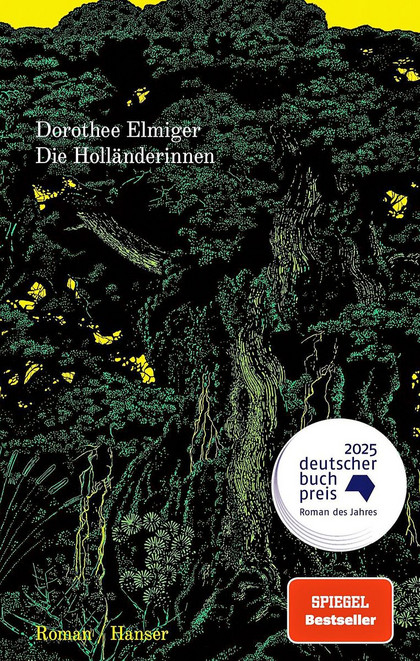
All three award juries were unanimous in praising the deft manner in which Dorothee Elmiger pulls her readers in and never lets go, taking them to a place where light and hope seem to vanish. In short, her novel has attracted universal acclaim.
Elmiger has indeed pulled off quite a feat. Her writing style is challenging, but what she writes is absorbing. In the strict mode of indirect speech, Elmiger narrates the account of an author who, in a lecture, talks about a theatre experiment: “A theatre director phoned her in January three years ago,” she said, asking her whether she would like to take part in a project. He wanted to investigate and re‑enact the disappearance of two Dutch women in the jungle.
With formal concision and subtlety, Elmiger draws her readers into a labyrinthine thicket of stories and references, where the actual events dissolve into the layered act of retelling. The speaker recounts how they would tell each other frightening tales in the jungle camp to ward off the horror stirred by the surrounding darkness and sounds. In her talk, the real jungle becomes a projection of existential fear. The speaker overlays lived experience with cultural references to theory, literature and film. She says that the theatre director often expressed his fondness for Werner Herzog, who always heroically defied every danger during his rainforest productions.
Elmiger knows that all storytelling is inherently uncertain and blurred, and that it always retains an element of indirectness, challenging the notion of what has truly taken place and what is true and genuine. Though it may sound abstract, the art of this novel is that it brings such considerations to life and seduces the reader onto all manner of digressive paths. Indirect speech, however challenging, is handled by Elmiger with such agility and subtlety that it haunts the reader beyond the last page.













Comments