

Menu
stage img
  • Books

Marianne Meier & Monika Hofmann | Back of the net

03.10.2025 – Theodora Peter

This summer’s Euro 2025 in Switzerland was a shot in the arm for woman’s football – with an attendance record, exciting matches and a sense of euphoria both inside and outside the stadiums. The Swiss team thrilled their home support on the big stage, reaching the quarter-finals for the first time.

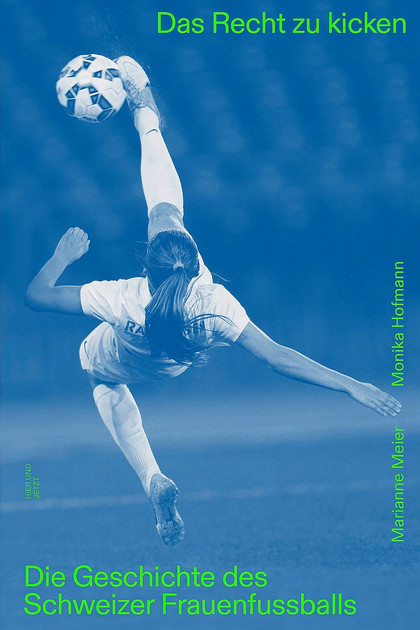
MARIANNE MEIER & MONIKA HOFMANN: “Das Recht zu kicken. Die Geschichte des Schweizer Frauenfussballs” (The right to play. The history of Swiss women’s football). Verlag Hier und Jetzt. Zurich, 2025. 335 pages, 39 francs.

Those dreamy days of summer should not disguise the fact that women’s football in Switzerland had been prevented for a long time from getting to this point. Women were still being denied access to this bastion of masculinity well into the 1960s. Unlike its English and German counterparts, the Swiss Football Association (SFA) had never banned women’s football as such. Nevertheless, Switzerland’s female football pioneers had to fight hard for the right to play, as historian Marianne Meier and gender scientist Monika Hofmann recount in their book.

Sisters Monika and Silvia Stahel – who founded Switzerland’s first-ever women’s football team, FC Goitschel, in the Aargau village of Murgenthal in 1963 – were two such pioneers. Once the ball got rolling, women’s football wanted to become more than just a novelty act at village tournaments. Yet attempts to get competitive football off the ground fell foul of the SFA, who instead sought to placate would-be female footballers by offering to train them as referees. Monika, Silvia and friends would have preferred to play but saw the refereeing course as a chance to get on the football pitch and show what they could do. They were only allowed to officiate junior matches.

The first Swiss women’s football league was finally established in 1970 – and welcomed to the SFA fold 20 years later. The beginning of the 1970s also saw the first women’s international matches. One of the best fledgling internationals of this era was Madeleine “Mado” Boll, who played for the Milanese works club ACF Gomma Gomma. The talented Boll had moved to Italy after being frustrated by the dearth of opportunities in Switzerland. Boll had even played a game for one of FC Sion’s junior boys’ teams at the age of 12 in 1965 – and became an SFA-registered player as a result. The governing body stripped her of her registration once it had noticed its “mistake”. Boll never gave up, paving the way for thousands of women and girls who have since followed in her footsteps.

Podcast series (in German) coinciding with the book: www.revue.link/pod

The Swiss women’s national team
Tournament-related articles

Comments

×

First name, surname and place/country of residence is required

Enter valid name

Valid email is required!

valid email address required

Comment is required!

Comment rules have to be accepted.

Please accept

* These fields are required.

top