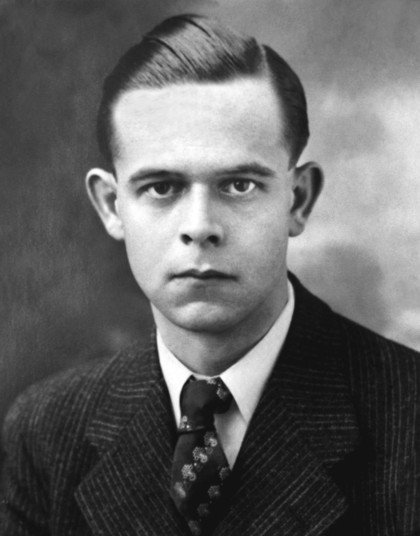
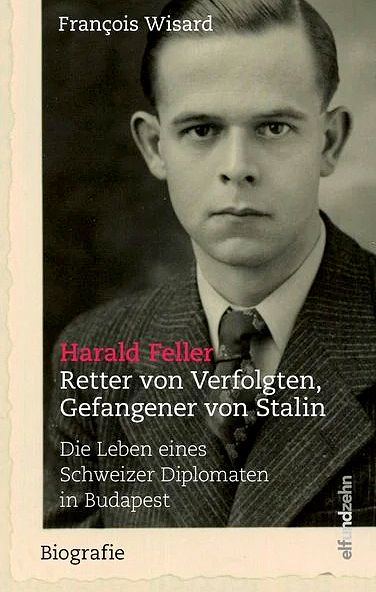
He hid Jews at his consular residence in Budapest during the final months of the Second World War. He was tortured by Hungarian fascists and later captured by the Russians. The life of Harald Feller from Berne reads like a film script, but few will have heard of his story. Until now. Historian François Wisard sets out to right this wrong in his new book – an objective and well-researched account published in French and German.
Feller, a young lawyer, worked from 1943 to 1945 at the Swiss legation in Budapest. There he experienced the German occupation, the Hungarian Nazis’ seizure of power, and the bloody battle for the city, which ended in victory for the Red Army. Feller stayed put at the legation, of which he became head in 1944. From 1944, the – officially neutral – Swiss Vice-Consul in Budapest, Carl Lutz, issued diplomatic letters of protection to tens of thousands of Jews, rescuing them from deportation and death (see “Swiss Review” 3/2023).
Feller was also a hero, saving the lives of at least 32 people. He gave exit and transit documents to some, he provided shelter at his residence to others. In doing so, he not only broke diplomatic rules but also put himself at great risk. The Hungarian Nazis interrogated and tortured him at the end of 1944. In February 1945, the Soviet secret service abducted Feller to use him as a bargaining chip with Switzerland. After one year in a Moscow prison cell, he was released in exchange for Russians detained in Switzerland. On his return, he learned that criminal proceedings had been launched against him.
The Swiss authorities were investigating whether he collaborated with the Nazis. This charge proved to be groundless, but Feller was never officially vindicated. Unlike Carl Lutz, who fought for recognition until his death in 1975, Feller withdrew from view. He worked as a public prosecutor in Berne and got involved in the theatre after retiring. Eva Koralnik contacted him in the mid-1990s. Koralnik was a child when Feller enabled her, her mother and her sister to escape to Switzerland. The Yad Vashem Holocaust Memorial honoured him at her request in 1999, naming the then 86-year-old as one of the “Righteous Among the Nations”.
Feller died in 2003. His life in the Swiss diplomatic service was like no other, Wisard writes. Yet Feller never considered writing his memoirs. He had only done his duty, he said.






Comments