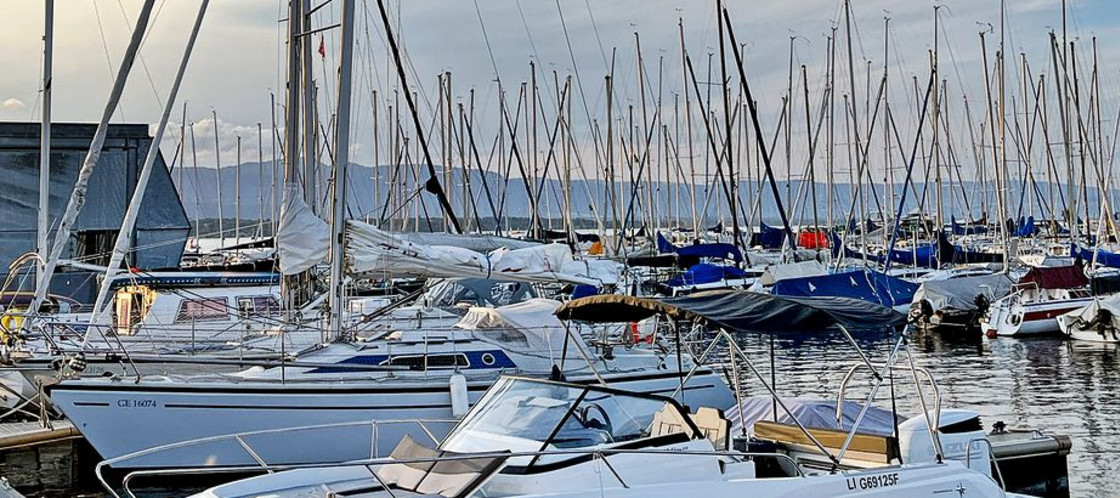
Switzerland features dozens of lakes that can be sailed by fans of water sports. It has one sailing boat for every 353 inhabitants, the fifth-largest number in the world. The country also has its nautical heroes.
Higher, farther, faster, more beautiful? In search of somewhat unconventional Swiss records Today: Switzerland has a high concentration of boats.
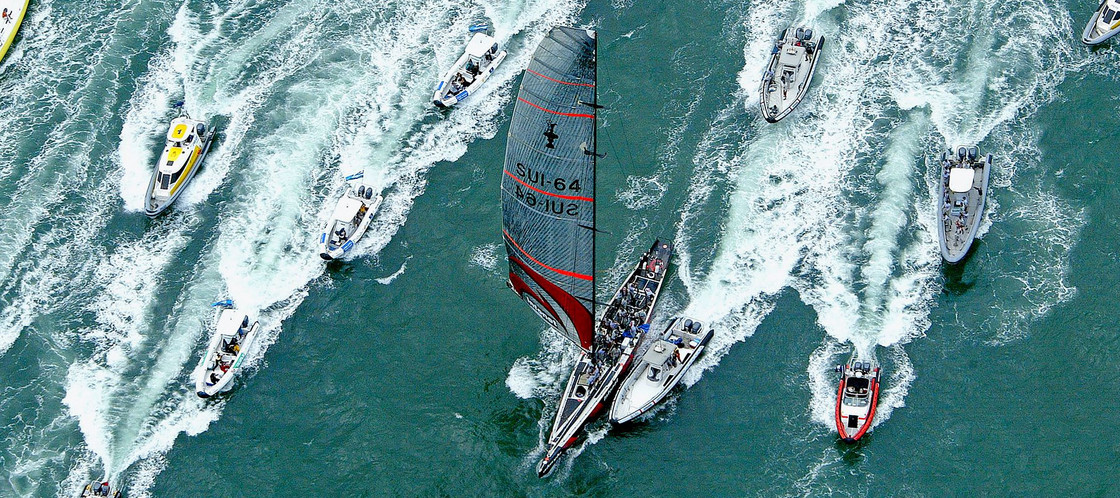
In comparison with other countries, Switzerland has among the highest number of boats per inhabitant. It may not have a sea, but it does have 150 sailable waterways and offers good conditions for taking to them, particularly in a sailing boat. “The mountains create thermals, which are ideal for the sport,” according to Olivier von Arx, president of the Association des propriétaires de bateau [Swiss boatowners’ association] (APB) in Geneva. “The first regattas on Lake Geneva took place in the 19th century, where transport ships competed,” says Bernard Schopfer, himself a sailor and the author of several books, including on the regattas at this world-famous boating spot. The specialist provided media support for Team Alinghi in the run-up to Switzerland’s first victory in the America’s Cup in Auckland in 2003. At that time, several sailors from the New Zealand team, who held the title, had defected to the Swiss team.
New Zealand, a seafaring nation, wanted to see Switzerland disqualified from the competition, arguing that the country had no access to the sea and that the Swiss campaign – run by billionaire Ernesto Bertarelli – was driven solely by money. Alinghi’s media team countered. “The rules of the America’s Cup state that you have to have a sea inlet. The Rhine counts,” explains Bernard Schopfer. Alinghi Switzerland had highlighted the considerable number of boats per inhabitant in Switzerland. “We also told the life stories of Swiss sailors such as Pierre Fehlmann,” the Geneva native recalls.
Fehlmann, who won the Whitbread Round the World Race in 1986, is a leading light in Swiss sailing. “He was the first great Swiss mariner. He made sailing famous and sailors like Dominique Wavre [who has sailed around the world ten times] took up the sport thanks to him,” remarks Daniel Rossier, former commodore of the Cruising Club de Suisse (CCS), which has 6,000 seafaring members. Today, Switzerland has at least another two top-level sailors to its name: Alan Roura, the youngest competitor in the 2017 Vendée Globe, and Justine Mettraux, who finished eighth in the 2025 edition of this solo round-the-world race in 18-metre IMOCA yachts. Both are also incidentally from Versoix, a small Geneva town on the banks of Lake Geneva!
“The accomplishments of Swiss sailors and Alinghi’s victory in 2003 really inspired people,” says Vaud sailor Mathieu Verrier, who has crossed the Atlantic in a 6.5-metre boat. He designed and built his sailing vessel for the 2009 Mini-Transat, a gateway race to the larger high-sea regattas. Another Swiss was involved: Geneva native Fabrice Germond, who works in the same Lausanne naval office, VMG Yacht Design, that the two founded. Mathieu Verrier sums up the status of sailing in Switzerland: “This country has people with the financial means to buy a boat; there are also plenty of lakes and getting to the water is easy,” he says. Switzerland has 20 lakes on which you can acquire your sailing licence. The champions are the residents of Vaud, who have over 15,000 registered boats. Next come Zurich (with 10,000) and Geneva (with 6,000). Mathieu Verrier owns a small catamaran, which can be sailed solo. He admits that he plans his life around the weather forecasts, “with a schedule dictated by the wind”.
“This country has people with the financial means to buy a boat; there are also plenty of lakes and getting to the water is easy.” Mathieu Verrier, sailor and naval architect
For some Swiss, lakes form the direct horizon. The country can lay claim to two of the largest lakes in western Europe: Lake Geneva and Lake Constance. People who boat on lakes are divided into two main if not opposing groups: those who sail and those with motorboats. The latter are growing in number. “A motorboat is like a car with two moorings; it has a steering wheel and burns fuel,” says Mathieu Verrier. Sailing, whose enthusiasts are gradually dwindling, requires extensive training. It is also time-consuming, admits author Bernard Schopfer, who devoted his Tuesday evenings to regattas on Lake Geneva for 30 years. He remembers returning to Geneva from Lutry on Sunday nights, by motorboat. “With a motorboat, you can head off from Lausanne to go and eat perch in Thonon, in France. With a sailing boat, you never know when you’re going to get there,” explainsVerrier.
What about taking to the high seas? “The difference is that lakes have no salt,” jokes the Vaud naval architect, who nonetheless warns that a lake like Lake Geneva can be subject to violent winds. “During the most recent world-record round-the-world yacht race, the strongest winds were encountered in Brittany, towards the end, with speeds reaching 80 km/h, but we’ve had 140 km/h on the lake in the past,” he recalls. Lakes can prove dangerous, as shown by the accident that occurred on Lake Zug in June 2024, where the wreck of a sailing boat was found 80 metres down, with the body of a sailor. The craft had sunk during a regatta. In 2019, strong winds descended on the Bol d’Or, the largest freshwater regatta in the world. For an hour, winds of over 100 km/h scattered the fleet, causing 212 of the 465 boats registered to abandon the race, but there were no victims.
These conditions are reminiscent of the open sea, and many Swiss people take to the sea for the first time every year, after obtaining their sea licence. Getting a licence involves taking 14 weeks of theory lessons and passing an exam. You then need to actively sail 1,000 nautical miles, the equivalent of 1,850 km at sea, validated by skippers. Every year, around 800 Swiss men and women sit this exam, according to Daniel Rossier, former boss of the CCS. “The Swiss licence is very demanding,” states the 82-year-old sailor, who has travelled across every sea. He says he was always amazed by the number of fellow Swiss he met in ports, particularly in the Caribbean.
“The first regattas on Lake Geneva took place in the 19th century, where transport ships competed.” Bernard Schopfer, seafarer and author
Another challenge is finding somewhere to moor. You need a berth if your boat has a keel or if it is too large to be easily placed in dry dock in the off-season. But people’s dreams of boat ownership are being stymied by a chronic lack of these berths. In late 2025, Geneva had a waiting list of over 1,000 people, according to the authorities. Paradoxically, only a minority of boats are regularly taken out on the water. The solution would be to share boats, or even remove the ones that are permanently moored, “but we cannot hold people to a timer”, says the head of APB, Olivier von Arx, who claims he never misses an opportunity to go sailing. “I go 300 metres out, I cut the engine and I enjoy the wide-open space and the peace and quiet,” he says.
Passing down a berth in the family, on the other hand, is still subject to very strict conditions. This means there is a permanent shortage of mooring berths. “And that’s a good thing,” remarks Bernard Schopfer, pointing out that Swiss lakes have only a finite area.
A nation of freshwater sailors
According to official data, there were 94,372 private boats registered in Switzerland in 2024, of which 63,446 were motorboats and 23,385 sailing boats. This means that Switzerland had one sailing boat for every 353 inhabitants, more than in France (380) or Italy (394). This score placed Switzerland fifth globally, with Norway (92) and New Zealand (173) arriving in first and second place.
Thank you for your comment. Your Comment Added Successfully.
Thank you for your comment. Comments are approved within one to three days.
Oops! Something went wrong, please try again later.
Comments :
Thank you for your comment. Your Comment Added Successfully.
Jean-Michel Richard, Maroc 30.04.2026 At 19:50
J'ai eu la chance de naviguer pendant plus de 40 ans sur le Léman, et j'ai aussi fait de nombreuses régates, et bien souvent le Bol d'Or. Des fois, on comptait une traversée, non en temps, mais en bouteilles, à cause de vents capricieux. Je ne peux que souhaiter plein succès à Alinghi qui se relance dans la course. Par contre, je suis extrêmement déçu de la Suisse sur les Class 55, régates qui ont lieu ces mois dans différentes parties de la planète. Peut-être, cette équipe devrait comprendre, à part les bonnes options sur le plan d'eau, qu'une régate se joue avec un départ réussi, et non en 5 ou 6e position. Mais bon, c'est vrai que ce n'est pas des navigateurs romands...









Comments
Comments :
J'ai eu la chance de naviguer pendant plus de 40 ans sur le Léman, et j'ai aussi fait de nombreuses régates, et bien souvent le Bol d'Or. Des fois, on comptait une traversée, non en temps, mais en bouteilles, à cause de vents capricieux. Je ne peux que souhaiter plein succès à Alinghi qui se relance dans la course. Par contre, je suis extrêmement déçu de la Suisse sur les Class 55, régates qui ont lieu ces mois dans différentes parties de la planète. Peut-être, cette équipe devrait comprendre, à part les bonnes options sur le plan d'eau, qu'une régate se joue avec un départ réussi, et non en 5 ou 6e position. Mais bon, c'est vrai que ce n'est pas des navigateurs romands...