Graubünden’s hairpin turn from car-free to four-wheel drive
03.10.2025 – Jürg Steiner
Grisons was stubbornly anti-automobile until 1925. One hundred years later, the Alpine canton now leads the way in road infrastructure and cars per capita. We look at the hairpins that were negotiated in between.
Higher, farther, faster, more beautiful? In search of somewhat unconventional Swiss records This edition: the canton that resisted the lure of the motor car longer than anywhere else.
Climate activists could maybe learn a trick or two from Grison’s decision to ban cars in the early 20th century – a move that went against the grain but commanded majority support within the canton.
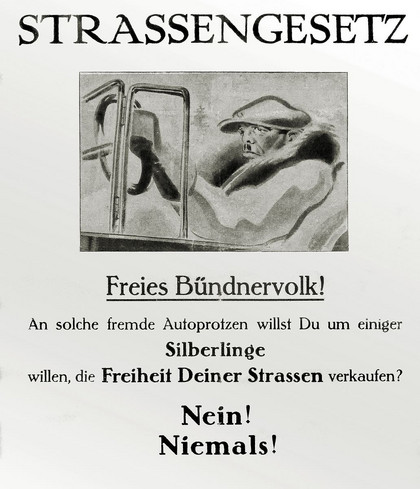
“People of Grisons!” exhorted the banner. “Do you really wish to graft and grovel for those who roar past you in their motor cars with an air of haughty contempt?” The rhetoric went full-throttle, more or less turning the anti-car argument into a class war. Twenty years after the first automobile had been patented by German engineer Carl Benz in 1886, cars were portrayed as “stink boxes” flaunted by flash tourists from the lowlands. The canton’s Alpine valleys would be engulfed in dust, noise and stench if nothing was done to stop them.
It took a remarkably long time for such views to change. Grisons became a car-free enclave, banning all motor vehicles between 1900 and 1925 – longer than anywhere else in Europe.
Bolting horses
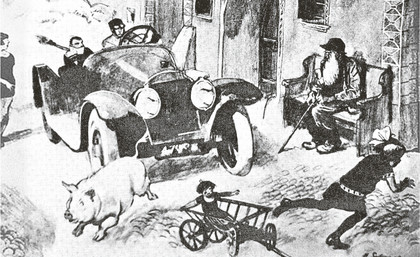
It was the Grisons cantonal government, no less, that crank-started the prohibition on cars, taking the public’s concerns seriously. Baulking at the prospect of these newfangled contraptions endangering other road users on the narrow, winding mountain passes of Engadine, it issued its canton-wide ban in 1900. If visiting motorists came rattling around the corner, carriage drivers feared that their horses would bolt and take them and their passengers down the mountain with them.
The canton’s Alpine valleys would be engulfed in dust, noise and stench if nothing wasdone to stop them.
Argument of those in favour of a car ban
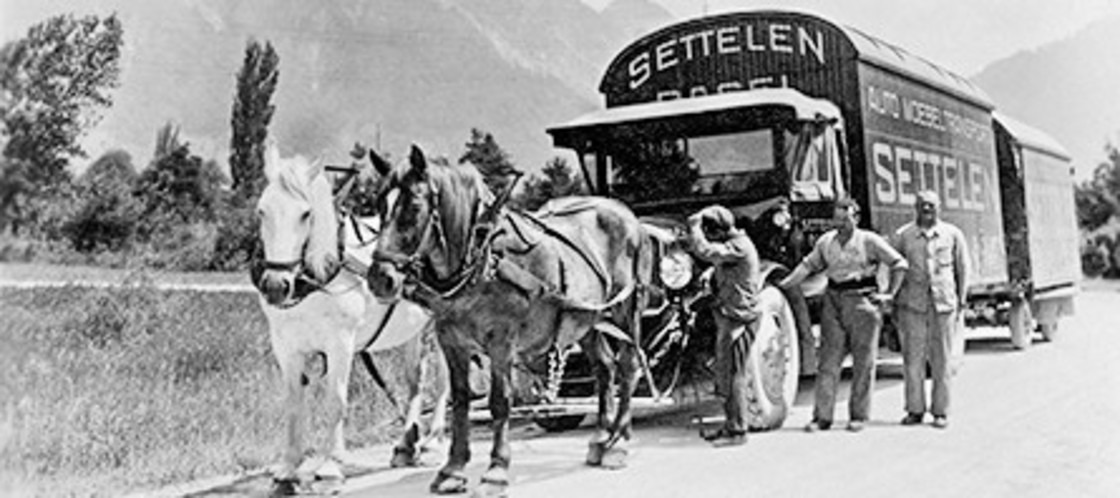
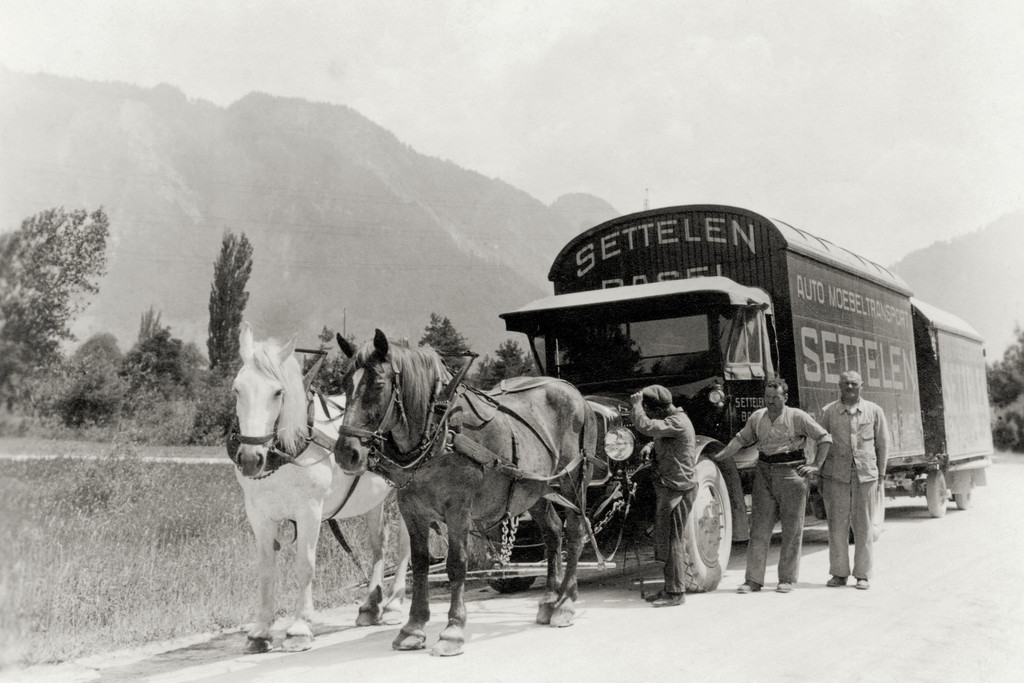
Cars quickly became an accepted form of transport elsewhere in Switzerland. After the ban came into force in Grisons, officials in Chur soon began to worry that being car-free could put the canton at an economic disadvantage. Yet the all-male electorate (women were not allowed to vote) remained unmoved. The ban survived nine consecutive popular votes, despite road users occasionally taking matters into their own hands: photos of the time bear testimony to vehicles being pulled by horses once they passed into Grisons.
It was not until 21 June 1925 that a narrow majority voted in favour of the motor car. Some suspect – not without reason – that the June date was chosen deliberately, because farmers would be up in the pastures and unable to vote no.
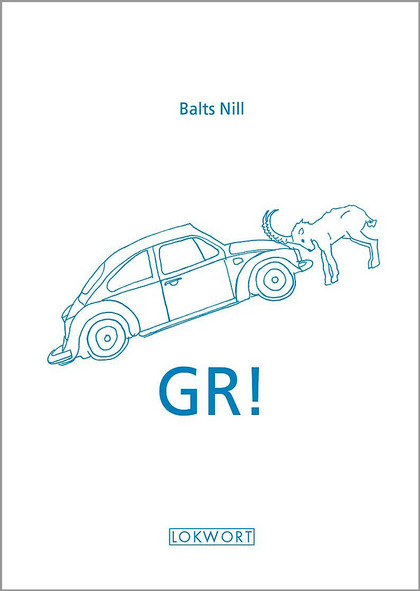
Balts Nill: GR! 2025, Lokwort Verlag, Bern, 24 pages. Über «Stinkkarren» und «Modespielzeuge». Ein Lehrstück zur Schweizer Demokratie.
More cars than households
Cars were permitted with immediate effect thereafter. Pockets of opposition remained, and nails would sometimes be scattered on roads. And the police were unforgiving towards motorists who broke the speed limit (12 km/h in towns and villages; 40 km/h outside built-up areas), as Bernese author Balts Nill recounts in “GR!”, a republished essay to mark the 100th anniversary of the ban being lifted.
From June 1925, the car began to take the 150 valleys of Switzerland’s largest canton by storm, it is now safe to say. Only 136 passenger cars were registered in Grisons at the end of 1925. The number is now 126,000.
The canton leads the way in numerous mobility-related “disciplines”, scoring above the national average in terms of cars per capita. There are significantly more cars than households in Grisons. Based on the latest information from the Federal Statistical Office, people in the canton have a penchant for buying big, expensive cars. And the proportion of new four-wheel-drive vehicles is higher than anywhere else in Switzerland.
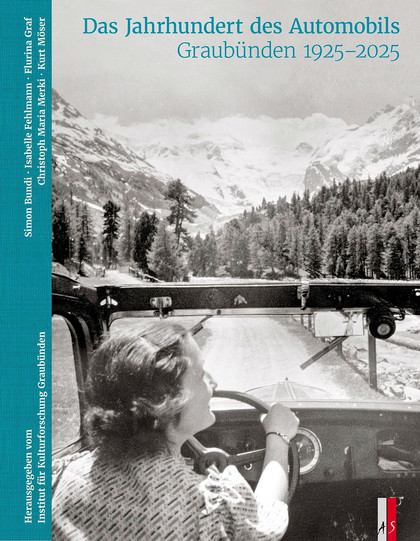
Simon Bundi, Isabelle Fehlmann, Flurina Graf, Christoph Maria Merki, Kurt Möser: Das Jahrhundert des Automobils. Graubünden 1925 bis 2025. Institut für Kulturforschung Graubünden. 2025, AS Verlag, Zurich
Driving over the mountains
Grisons historian Simon Bundi has followed the story of automobiles closely. He curates the car museum at Emil Frey Classics in Safenwil (canton of Aargau) and has led a research project devoted to 100 years of the motor car in Grisons, the results of which are now available in a book.
There are several reasons why the ban lasted so long, Bundi tells us. Grisons is Switzerland’s most sparsely populated canton, statistically speaking. But it has an extensive transport network. Back then, there were significant doubts as to whether a relatively small number of taxpayers would be able to cover the cost of maintaining roads for cars. People feared that the financial burden might be too great.
At almost the same time as the advent of the automobile, Grisons had also made the expensive decision to establish the Rhaetian Railway (RhB). The RhB regarded the car as a competitor for the transport of goods, which is why the canton continued to ban vans and lorries from valleys accessible by train even after 1925.
The tone of the argument against cars was, at least for a while, very reflective of the class struggle. Photo provided
The Confederation eventually lifted the handbrake. In 1934, the Federal Council and parliament decided to expand Switzerland’s mountain road network and pledge major financial assistance to the Alpine cantons. Grisons had lobbied heavily for this money and now began to build roads with a vengeance. Car mania soon gripped the canton.
As early as 1929, the Upper Engadine hosted an international car show attracting 10,000 visitors. The canton began clearing the Julier Pass for winter traffic in 1934, making it the first alpine pass to feature asphalt roads and turning the passage over the mountains into a major tourist attraction. As mass tourism expanded after the Second World War, more and more people wanted to drive to ski resorts in cars. Grisons, once anti-car, was now ready.
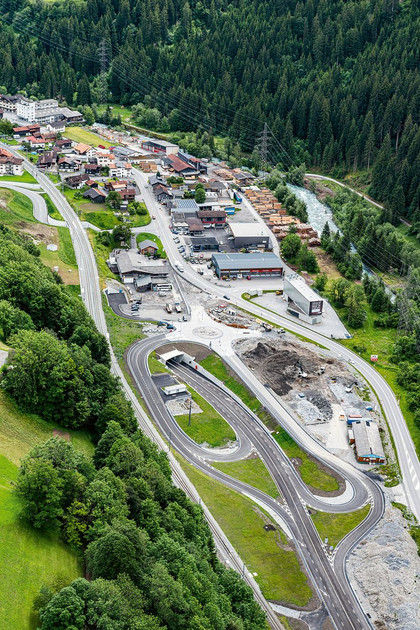
Right: Picture taken from the air during the construction of the Küblis bypass. As it makes clear, Grisons is also the land of bypasses. Photo provided
Canton of bypasses
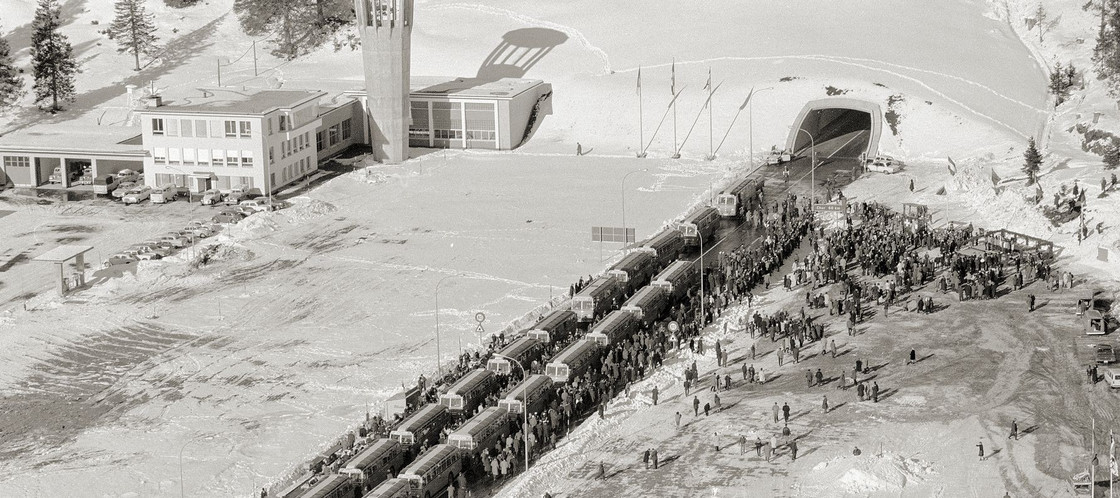
Switzerland’s second-ever stretch of motorway was built in the Rhine Valmotorway was built in the Rhine Valley between Trimmis and Landquart in 1958, while the first road tunnel through the Alps, between Hinterrhein and San Bernardino, was inaugurated on 1 December 1967 – 13 years before the Gotthard. Simon Bundi’s research shows how pioneering road infrastructure was even celebrated on postcards, bearing testimony to Grison’s proactive policy on personal mobility.
Without cars, the canton’s economic transformation into a tourist destination would have been unthinkable. But more road traffic meant that the anti-car lobby at the beginning of the 20th century may have had a point. Towns and villages turned into traffic bottlenecks, leading to air pollution, noise and an increased risk of road accidents. Grison’s approach, both then and now, has been to build additional roads that bypass residential areas. “Grisons is the canton of bypasses,” says Bundi. “No other canton has so many of them. Usually costing a lot of money, they help to funnel people into the tourist destinations more quickly.”
Leaflet distributed by opponents of automobile in Graubünden, 1925
One thing has not changed in Grisons since the end of the car ban: traffic levels continue to rise, and a large proportion of traffic originates from outside the canton. Motorists are feeling the squeeze in urban areas, with no more than half of households in cities like Berne and Zurich still owning their own car. Yet four wheels remains the mode of choice for people travelling into the mountains. Congestion at the busy Landquart motorway junction has become the norm on sunny winter Sundays.





Comments
Comments :
Lovely history, sad that they voted, when the farmers were away tho. I hope there are more history articles. Thank you.