Swiss-EU relations – major decisions loom for parliament
17.07.2026 – Theodora Peter
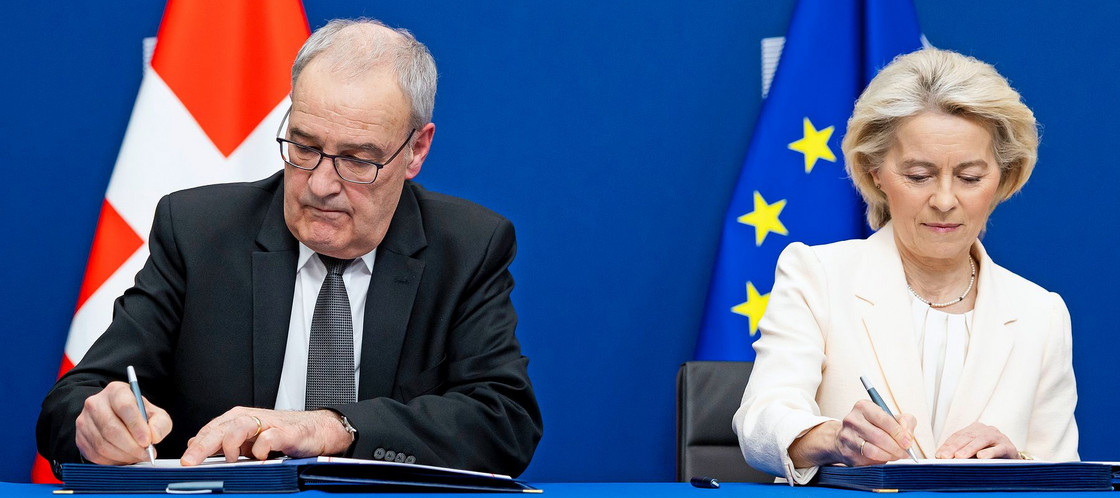
Switzerland has negotiated a new set of agreements with the European Union (EU). The federal parliament will now review and debate the package, which exceeds 1,000 pages – after which voters will have the final say. Some important and contentious issues are at stake.
Why the need for these agreements in the first place?
The existing agreements with the EU (Bilaterals I and II) are over 20 years old. The Federal Council wants to consolidate and strengthen the bilateral framework with a new package, Bilaterals III, which ensures continued frictionless participation in the EU single market, the Swiss economy’s most important marketplace, and preserves freedom of movement, giving Swiss citizens the right to live and work in any country within the European Economic Area.
What areas does the new package of agreements cover?
The package consists of two elements: “stabilisation” and “further development”. Its first part contains five existing agreements that have been amended with regard to freedom of movement, land transport, air transport, agriculture, and mutual recognition of product standards. The second part (“further development”) features three new agreements on electricity, health, and food safety. As far as the EU is concerned, the whole set of agreements can only be ratified as a complete package and cannot be unpicked. Yet parliament could still decide to put Bilaterals III to the electorate in two stages.
Consultations are likely to drag into 2027, with voters possibly not having their say until 2028.
Where are the biggest sticking points?
There is controversy on institutional issues like the adoption of EU law, or what to do when there are disputes between the two parties. In the case of agreements relating to the European single market, Switzerland will have to adopt any new EU rules. Referred to as a “dynamic” form of alignment, this is the same mechanism that applies to the Schengen Border Code. Switzerland will now have an informal say in developing such rules. It can refuse to adopt a rule outright but, in doing so, would have to expect retaliatory measures from Brussels. Dispute resolution is another tricky issue. If Berne and Brussels disagree on how an agreement should be interpreted, an independent arbitration panel steps in. If a conflict involves a question regarding the interpretation of EU law, the arbitration panel must refer the matter to the Court of Justice of the European Union (CJEU) in Luxembourg, whose job is to ensure that EU law is followed and applied in the same way across the EU. The Federal Council has emphasised that the CJEU cannot decide on specific disputes or intervene of its own accord in arbitration proceedings.
What do the political parties think?
The rightwing-conservative SVP is the only government party to oppose the package categorically, warning of “foreign judges” and a loss of Swiss sovereignty. The other parties represented in the Federal Council – the SP, FDP, and Centre – essentially support the new package, as do the Greens and the Green Liberals. The trade unions are also in favour, provided parliament approves measures to protect wages. The economiesuisse business federation, for its part, believes that the agreements are crucial to Switzerland’s competitiveness.
Is the “Fifth Switzerland” affected?
Essentially, nothing will change for the 540,000 or so Swiss Abroad who currently live in European countries. But future generations of Swiss who wish to benefit from freedom of movement and emigrate to the EU will be affected. The advantages of free movement also include mutual recognition of university qualifications and the transferability of social security rights.
Can Switzerland limit immigration unilaterally?
As a rule, citizens of EU states may live, study and work in Switzerland thanks to freedom of movement. However, Switzerland has negotiated a safeguard clause stipulating that it can limit immigration if “serious economic or social problems” arise. But the EU would likely retaliate – for example, by enforcing reciprocal immigration restrictions on Swiss citizens.
When will the electorate vote on the Swiss-EU package of agreements?
First of all, the National Council and the Council of States are expected to review the package, starting in the 2026 autumn session. The extensive and complex agreements constitute one of the biggest agenda items of recent years. Ratification will require parliament having to amend 36 pieces of legislation and pass three new laws. Consultations are, therefore, likely to drag into 2027, with voters possibly not having their say until 2028. It is still unclear whether the vote will only require a simple majority of the electorate, or whether a majority of the cantons will also be necessary for a binding result. The voting procedure is a highly contentious, politically charged issue.
Why is a majority of the cantons pivotal?
The bar for a yes vote is raised if the majority of cantons must also vote in favour. This would suit opponents of the package, who say a majority of the cantons is necessary because the agreements impinge on the Federal Constitution. But the Federal Council sees no absolute legal basis for this. Supporters believe a simple majority of the electorate is sufficient, as was the case in the votes on Bilaterals I and II. The chances of a yes vote increase if a majority of the cantons is not required. Parliament must ultimately decide which voting procedure will apply.
What happens if there is a no vote?
If the package of agreements fails to pass, the existing bilateral agreements remain valid but, according to the Federal Council, will become less important and effective because they will no longer be updated. Maintaining the status quo is not an option for supporters, because Switzerland would not be able to strike new deals with the EU in areas like the electricity market if bilateral relations are not stabilised. Switzerland also risks being excluded from EU schemes like the Horizon research programme. But opponents say Switzerland should go it alone and secure free trade agreements around the world instead of signing EU treaties.
Dossier: Switzerland and its neighbours
Federal Council | Switzerland and the EU: better and more predictable relations








Comments
Comments :
Schweiz und die EU. Was da so schleichend vor sich geht, ist unterste Politschublade. Die Schweizer Regierung sollte sich weniger darum bemühen zu erklären, was es kostet sich nicht zu beugen, sondern die grundsätzliche Frage aufwerfen, was es kostet die Selbständigkeit zu verlieren, was es für die Schweizer bedeutet vom Freien Staat zum zum EU-Anhängsel degradiert zu werden!