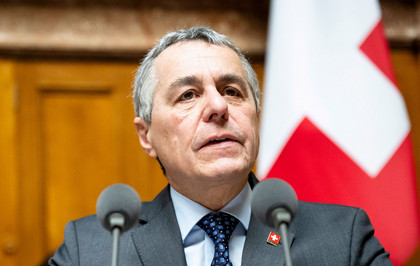
The Federal Council had cited violations of international humanitarian law as the reason for joining the EU’s economic sanctions on Russia. “Playing into the hands of an aggressor is not neutral,” Foreign Minister Ignazio Cassis (FDP) explained at the time. But the government ruled out supplying weapons and protective equipment to Ukraine. The international law of neutrality precludes Switzerland from affording preferential treatment to any warring party – and the Federal Council has so far stuck to this strict interpretation of impartiality, even if doing so weakens the effectiveness of sanctions against the aggressor.
A majority in parliament oppose the initiative
Until now, the Federal Constitution has contained no explicit definition of Swiss neutrality. But it obliges the Federal Council to take measures to safeguard Switzerland’s external security, independence, and neutrality. The Federal Council sees no reason to amend these provisions. Since the birth of the federal Swiss state in 1848, there has been a conscious choice not to make the wording more precise, Cassis explained during a debate on the Neutrality Initiative in parliament. This flexibility was necessary and had proven itself in the last 175 years. “Neutrality is an instrument and not an end in itself.”
Besides the Federal Council, a majority in parliament also oppose the initiative. Those who would vote no warn against Switzerland limiting its foreign policy options in a time of uncertainty. The initiative promises clarity but inflicts a straitjacket, said the FDP National Councillor for Aargau, Maja Riniker, during the parliamentary debate. “Maintaining neutrality by shielding ourselves from the world is utopian.” There is particular pushback on prohibiting economic sanctions against warring countries. Had Switzerland not aligned itself with the EU sanctions against Russia, “we would more or less have become Putin’s European lifeline”, said the SP National Councillor for Grisons, Jon Pult.
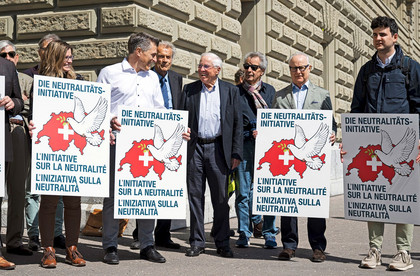
The SVP, the only party to support the initiative, wants the Federal Council’s interpretation of neutrality to be strictly limited. Preserving neutrality requires courage and backbone, it says. SVP National Councillor for Geneva, Céline Amaudruz: “It is not our role to be following the herd, but to keep channels open for negotiation.”








Comments
Comments :
Mr. Blocher, what if the situation were reversed? What if some country were to attack Switzerland? Wouldn't you want other nations to boycott the aggressor? What is this hypocrisy? Enough with the cowardice. From World War II to the present day, we have seen what your neutrality is worth—and the havoc it wreaks.
A quoi sert une neutralité, quand n'est pas stricte, mais peut être adapté au bon vouloir et au jugement de notre gouvernement? Sur quelle base? Quel pays étranger veut se fier à et respecter une telle neutralité en cas de conflit? A quoi sert-elle en réalité?
Toute sanction envers un pays étranger est l'expression d'un parti pris et d'une hostilité envers un peuple (et non pas uniquement envers un gouvernement) qui suscite une réaction hostile envers notre pays. Un gouvernement en guerre ne va pas se laisser impressionner par des sanctions; il poursuit des objectifs plus importants à ses yeux. D'autre part, la prise de sanctions anéanti toutes tentatives pour trouver l'appaisement par la voie diplomatique.
Si l'on peut "adapter" notre neutralité selon la volonté du gouvernement, un autre gouvernement peut aussi adapter le "droit international" selon sa volonté. Le droit international est un accord volontaire comme l'est la neutralité, on les respecte ou non. Qui sera le juge?
Immer wieder der Versuch, die Neutralität zu klassifizieren? Immer noch nicht müde darob? Begreift doch endlich: DIE Neutralität ist seit Gedenken nicht mehr und nicht weniger als ein Künstlername der hohen Politik.