Dinosaurs and their crocodile cousins are all the rage with the Swiss
17.07.2026 – Stéphane Herzog
There are three ways to view dinosaurs in Switzerland: the tracks in Vieux Émosson (Valais), the Jurassica Museum (Jura) and the site of Frick (Aargau). Even though the Valais tracks are actually from distant cousins of the dinosaurs, these locations really draw the crowds.
“A footprint tells us about the animal’s gait, its stride and its weight.” Lara Sciscio, specialist in dinosaur tracks
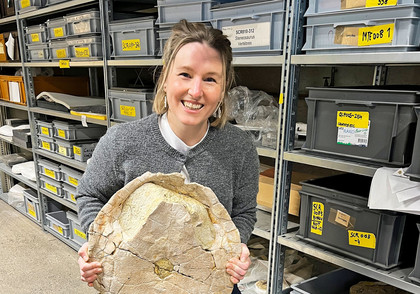
Doctor Lara Sciscio, a specialist in dinosaur tracks, pushes open a large wooden door leading into a cellar. This is the cellar of Porrentruy Castle (Jura), which still houses prisoners on the upper levels, as we learn from our second guide, palaeontologist Gaël Spicher, a PhD student at the Jurassica natural history museum (undergoing renovation until 2027). This treasure trove is dedicated entirely to the finds unearthed at the famous digs that formed part of the A16 Transjurane motorway construction. The project, launched in the early 2000s, took a path through an area that it was thought might feature interesting remains. A team of archaeologists was assembled to carry out some emergency digs, as recounted by scientific journalist Pierre-Yves Frei in his latest book*, dedicated to dinosaurs in Switzerland. In February 2002, near Courtedoux (Jura), some dinosaur tracks were uncovered. They were from sauropods. These long-necked, broad-footed quadrupeds were herbivores. They lived during the Upper Jurassic period, approximately 152-157 million years ago. “They would not have hunted us as food, in the way that, for example, a T. Rex would; T. Rex lived in the Cretaceous period and its tracks have been found in the US,” explains Sciscio.
The Jura site contains around 700 trails – from dinosaurs crossing Europe – and 14,000 footprints. A real jackpot for the researcher, who joined the Jurassica Museum four years ago from her native Zimbabwe. “A footprint tells us about the animal’s gait, its stride and its weight,” says the palaeontologist, who specialises in ichnology (the analysis of footprints). What about the skeletons? Here, there are none. But sauropod remains were discovered in Moutier (Jura) as early as the 19th century, the scientist explains. The animals in question looked like the Diplodocus.
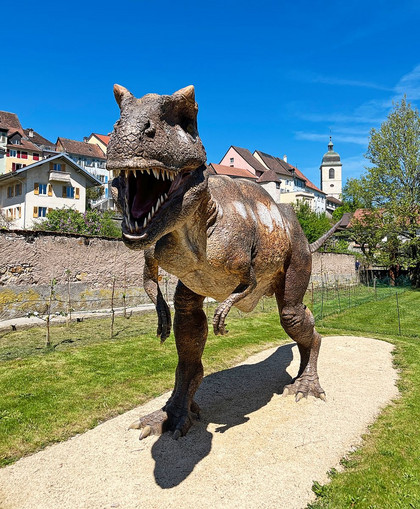
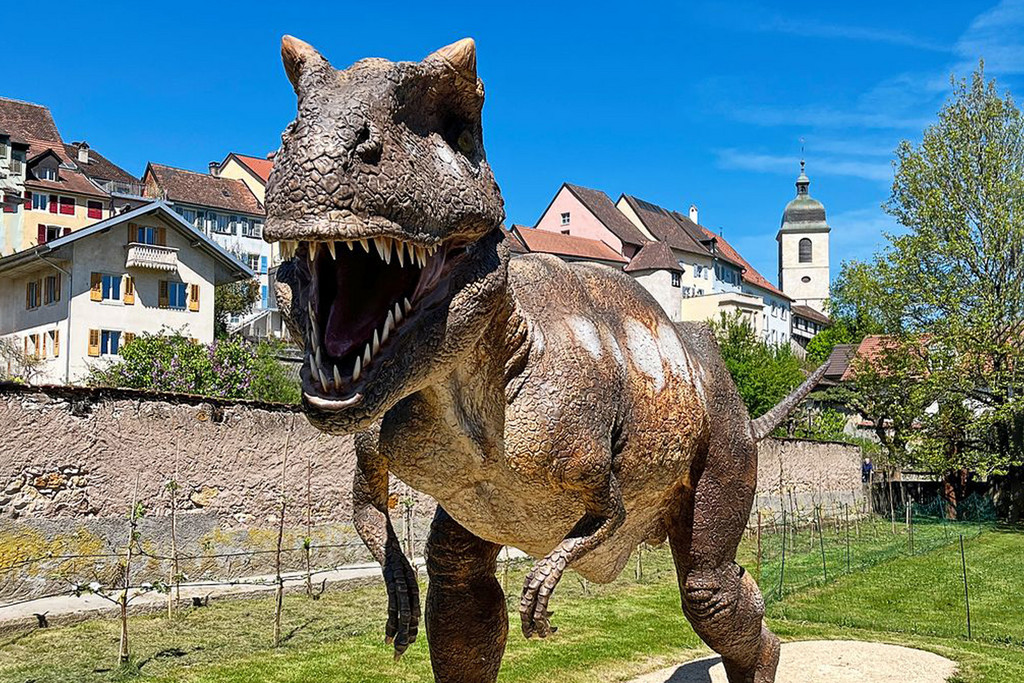
Millions of years ago, theropods lived in Switzerland. There is a replica outside the Jurassica Museum in Porrentruy. Photo: Stéphane Herzog
Tracks 1.20 metres in diameter
Our two scientists open boxes containing fossils unearthed during the Transjurane digs. One is the fossilised stomach of a tortoise. It was alive 152 million years ago, during the Upper Jurassic, whose name itself derives from the Jura. As soon as each fossil or item of animal remains is discovered, it is covered in plaster to protect it, then removed from the rock and transported to the lab for cleaning. There is enough work here to keep scientists busy for decades. But where are the dinosaurs? The palaeontologists slide out a heavy vertical file. It contains the round tracks left by an Amanzia sauropod. This creature had feet as large as columns (1.20 m in diameter in the largest footprint), a long neck, a small head and a long and very strong tail. It stood around four metres at the hip. The “drawing” is the result of comparisons with other sauropods, as these digs did not uncover any skeletons of these animals, adds Sciscio. In order to identify an animal with certainty, however, you need to have both its tracks and its skeleton. The two researchers take us into the courtyard of a training centre, where we can see the basement through glass. This view lets us observe tridactyl (three-toed) tracks, left by theropods, bipedal dinosaurs that were carnivorous and close relatives of the T. Rex. As a reminder, this monster lived up to the extinction of non-avian dinosaurs; modern birds are actually living dinosaurs. The other dinosaurs died out 66 million years ago.
“Vieux Émosson might be the most famous mistake in Swiss palaeontology.” Pierre-Yves Frei, scientific journalist
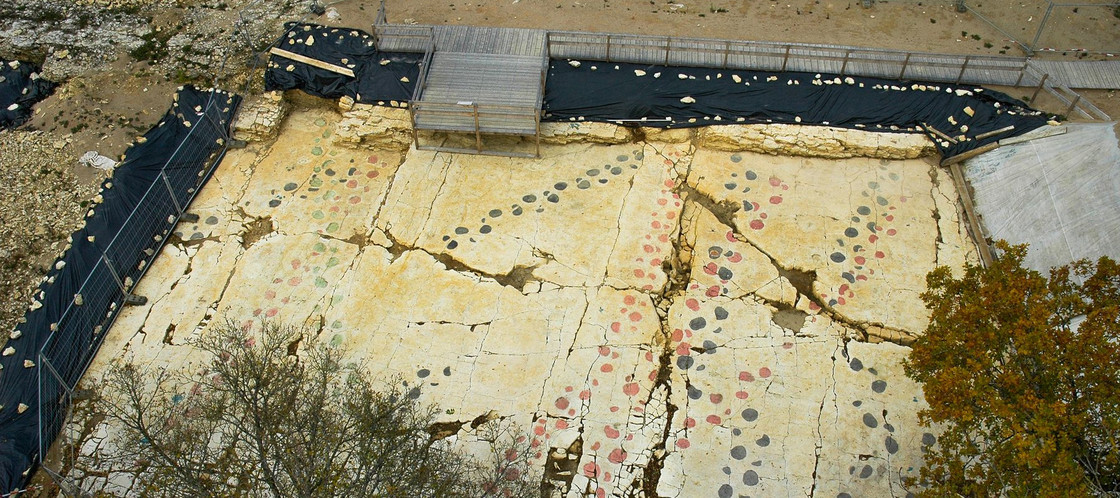
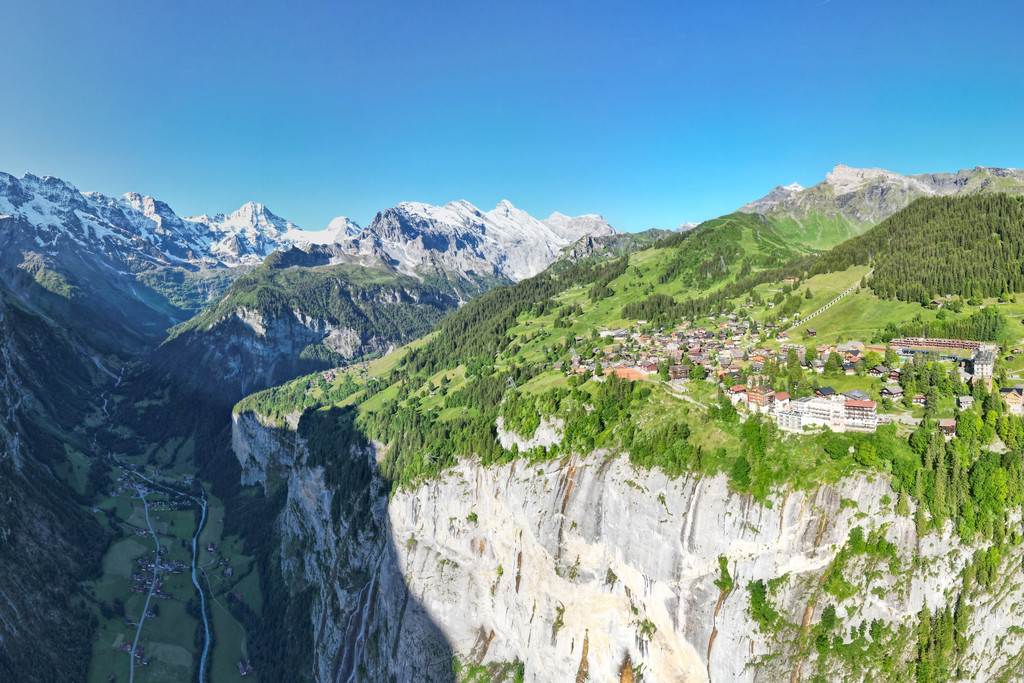
Another famous location in Switzerland for observing the tracks of these varied and occasionally terrifying animals is Vieux Émosson, in Valais. These tracks are located at an altitude of over 2,400 metres. The site turned out to be full of surprises, as palaeontologists discovered years later that the animals in question could not have been dinosaurs. “These tracks were left behind by close relatives of the dinosaurs, with whom they shared a common ancestor in the early Triassic,” reveals Pierre-Yves Frei. How this misunderstanding came about features in his book. In 1976, French geologist Georges Bronner and friends decided to travel to the region of the Émosson dam on foot. On the second day, the group reached the region of Vieux Émosson, the name of the first dam built in the valley. Georges Bronner took some photos with his daughter Sylvie. The Alsace native’s attention was suddenly drawn to a slab half-submerged in snow. These were not merely holes: they were tracks. News of this discovery travelled around the world and the site would become – and remain – the location of the Vieux Émosson dinosaurs. Why were they thought to be dinosaur tracks? The first reason, the Geneva journalist explains, was that the tracks were very numerous but they were of mediocre quality. They suggested the presence of three-toed footprints, characteristic of dinosaurs. In reality, all the footprints are five-toed.
Another difficulty was that the sedimentary rock did not contain any fossils, which made precise dating impossible. The pioneers of this discovery had put their faith in the tracks being 230 million years old. However, the rock itself is 240 million years old, and dinosaurs had only just started appearing in the southern hemisphere at that point. So, the received wisdom is no longer dinosaurs but pentadactyl (five-toed) animals, upright crocodilians almost three metres long and with powerful jaws, belonging to the division of Pseudosuchia. The other division of the clade was Avemetatarsalia, the division of the dinosaurs.
The most well-known dinosaur fossil site in Switzerland stems from a misunderstanding.
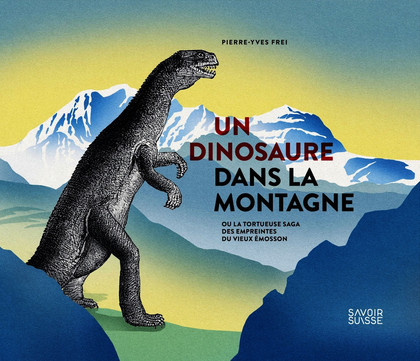
Pierre-Yves Frei: “Un dinosaure dans la montagne”. Savoir suisse, Lausanne 2026, 192 pages
Frick and its perfect skeletons
In his book, Pierre-Yves Frei mentions another legendary location in the history of dinosaurs in Switzerland: the quarries at Frick (Aargau), where, in 1976, Swiss palaeontologist Ben Pabst discovered the fossilised remains of dinosaurs around 210 million years old, Plateosauruses, in the clay. These herbivores were eight metres long and weighed four tonnes. The museum in Frick hosts a complete skeleton of the animal. This corner of Aargau is believed to contain around 500 fossils per hectare. Why are there so many? “During the Triassic, the bodies of water on this large plain became mud pools in the dry season. The bigger dinosaurs were driven by thirst to wade in regardless and they could not always escape,” the author explains. “I’d hate to imagine getting trapped there, but it leaves valuable evidence,” the Geneva native adds.




Comments