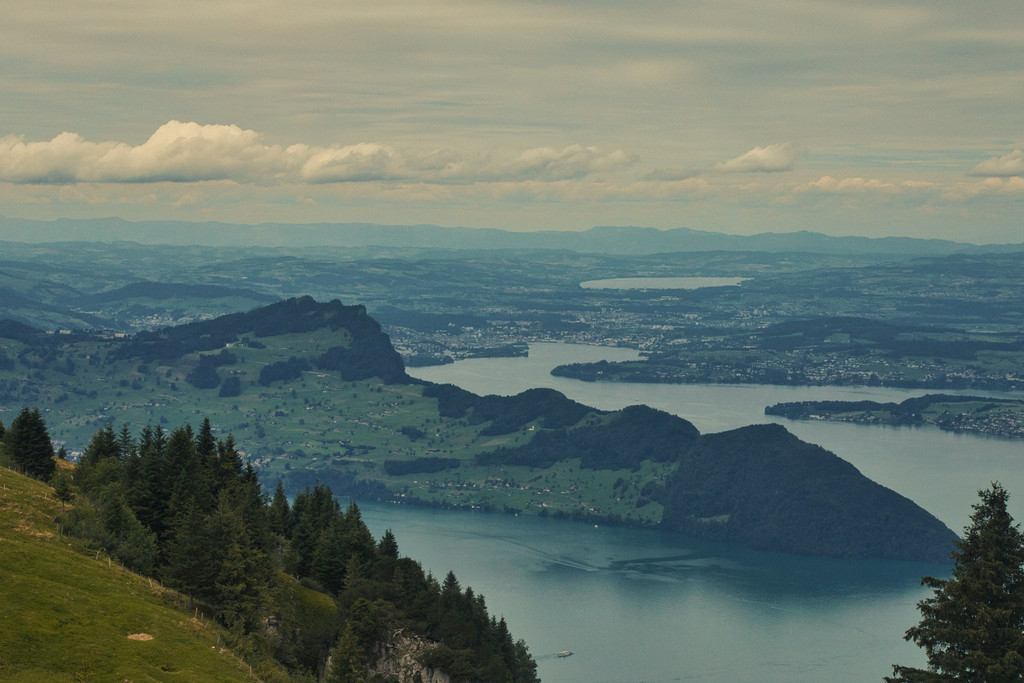
In 1601, at least 10 people lost their lives in a tsunami on Lake Lucerne that was triggered underwater after an earthquake. Could such a disaster happen again?
Higher, farther, faster, more beautiful? In search of somewhat unconventional Swiss records Today: extreme waves
People tend to associate tsunamis with oceans. Many will recall the devastating Indian Ocean tsunami that killed around 230,000 people on 26 December 2004, triggered by an earthquake off the west coast of Indonesia.
But tsunamis in Switzerland? That scenario is nowhere near as improbable as it may seem. “The danger is real,” says professor of geology at the University of Bern, Flavio Anselmetti, who has been studying this possibility with the help of colleagues from Berne and ETH Zurich for over 10 years.
Probably no other tsunami in Switzerland has been documented to such a degree as the one that occurred on 18 September 1601 on Lake Lucerne – also after an earthquake. “With a (reconstructed) magnitude of 5.9, the quake violently shook the whole of central Switzerland. Trees and houses were uprooted, mountainsides crumbled.”
This quote is from a Swiss National Museum blog post written by 32-year-old historian Noah Businger, who found out about the event while studying at university. Businger, who hails from central Switzerland, was eager to learn more and has proceeded to supplement historical knowledge with the latest research.
No singing or shouting
Lucerne’s official chronicler Renward Cysat (1545–1614) recorded details of what happened. Waves up to five metres high crashed into the shoreline near Buochs, penetrating as far as one kilometre inland. At least 10 people died. Boats were swept well beyond the shore. In Lucerne, the water in the River Reuss was repeatedly drawn right out into the lake only to suddenly come rushing back in again. This was what we would now call a seiche, or standing wave, where all the water oscillates back and forth from one side of the lake to the other as if it were in a bathtub.
The locals had no idea what had hit them. “It must have been terrifying,” says Businger. People thought it was God’s punishment for their sins. The authorities sought to placate the Almighty and banned excessive feasting and celebrating as well as dancing, singing and shouting for several months.
But what exactly had happened? Scientists now know, thanks not least to what Cysat wrote. The boats had run aground as much as “two halberds” – roughly four metres – above the normal waterline, making it possible to deduce how high the waves would have been. Talking to Flavio Anselmetti, however, it becomes clear that the earthquake did not cause the tsunami directly.
“Like a slab of snow that comes loose”
Many of the slopes surrounding the lake basin at Buochs continue for 200 metres underwater, where large amounts of mud and rock would have piled up over many centuries. The earthquake sent much of this material sliding. Anselmetti: “It was like a slab of snow coming loose.” Multiple sediment avalanches descended to the bottom of the lake, pushing water upwards – after having pulled water downwards into the space it had left behind. Lake Lucerne would have been in tumult.
The crucial point is this: when all the water at a specific point rises up from the bottom like a column, the energy is intense – generating a tsunami wave that travels quietly but barely loses any strength.
If a massive chunk of rock fell into the lake, this would cause a different kind of wave, Anselmetti says. The surge may well be even greater than a tsunami wave to begin with, but would weaken very quickly. The transfer of energy would be relatively modest, because most of it would be restricted to the surface of the lake without large masses of water being displaced.
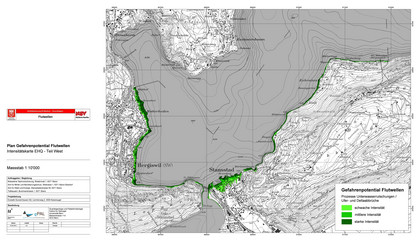
The canton of Nidwalden has produced a map showing which areas of shoreline would be flooded in the event of a tsunami. Map: provided/canton of Nidwalden
Several risk factors
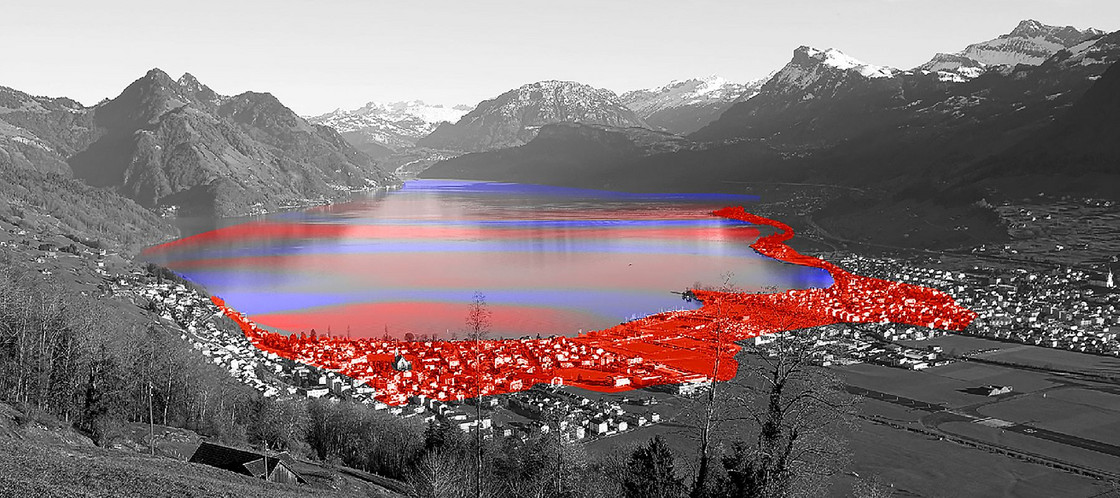
But what about the current tsunami risk on Switzerland’s lakes? According to Anselmetti, two exacerbating factors come into play: firstly, “susceptible” underwater slopes packed with mud, and secondly, flat shorelines. The flatter the land, the further a wave can penetrate. Buochs has both these ingredients. However, most of the underwater slopes in Lake Lucerne expelled so much sediment in the 1601 earthquake that it will still take centuries before similar deposits build up to a critical level again, he says.
An underwater slope is “susceptible” if it has a gradient of around 10 to 25 degrees, he continues. Any steeper, and barely any sediment would settle. Any flatter, and no big slippages would occur. Lakes Geneva, Thun and Zug all have underwater slopes that could collapse and trigger a tsunami after an earthquake. Surrounded by steep mountains, lakes Oeschinen, Walen, Lungern and Brienz are examples of lakes where rockfall-induced wave surges are to be expected, he explains.
Some Swiss cantons are in the process of mapping tsunami risk. Nidwalden, which bore the brunt in 1601, is the first canton to have done so already – given that there are insurance considerations to take into account, among other things. Wave surges like the one in 1601 would still cause significant damage today.
Earthquake? Get away from the shore
Thanks to modern multibeam sonar systems, it is now possible to map lake floors with centimetre accuracy and reveal structures and patterns that were unknown until recently. Lake Zurich shows sections where slopes have already given way. Objects dating back to the Stone Age were discovered in Lake Constance.
Anselmetti is spearheading the work. Scientists can now pinpoint “loaded” underwater slopes. These analyses are ongoing, he says. The results will be incorporated into hazard maps.
But how could people be warned if there were another tsunami? Advanced buoy-and-siren warning systems are a challenge to deploy, given the rarity of such an event and the short warning times involved, the geologist says. Yet simply being knowledgeable of the danger can itself make a difference, as it would anywhere around the world. If you are near a flat shoreline during an earthquake, it is advisable to get away from that area. “A tsunami is most likely coming.”






Comments