Mirjana Spoljaric Egger | The first female president of the ICRC
17.07.2026 – Stéphane Herzog
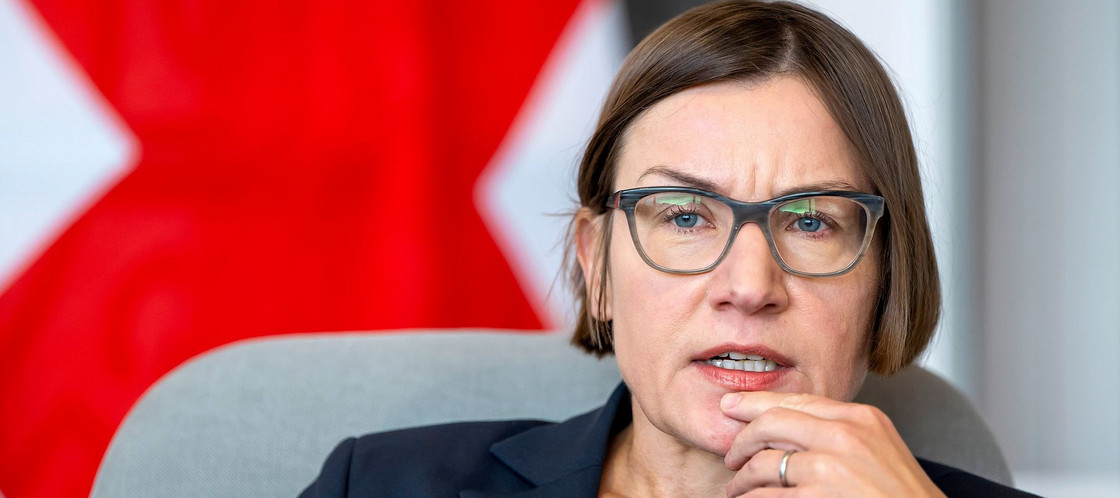
Mirjana Spoljaric Egger, appointed in late 2022, is the first woman to head the International Committee of the Red Cross. The war in Ukraine has led to a fall in donor contributions. Humanitarian law is increasingly being flouted. The president has launched a campaign to revitalise it.
In an organisation that claims to be determined to achieve gender parity in executive roles, the appointment in October 2022 of the new president of the International Committee of the Red Cross, diplomat Mirjana Spoljaric Egger, makes a statement. “It was about time,” says Philippe Lazzarini, former head of the United Nations Relief and Works Agency for Palestine Refugees in the Near East (UNRWA), pointing out that this particular glass ceiling has already been broken in several UN agencies.
The Croatia-born ICRC president who hails from Basel experienced a baptism of fire through Russia’s attack on Ukraine in early 2022. This placed the ICRC under considerable pressure. “Every campaign run in the field is subjected to intense scrutiny. It makes the work more delicate and complicated,” according to someone familiar with the agency. The ICRC has been criticised by the Ukrainian authorities, who have condemned the fact that the institution’s delegates are unable to gain full access to the country’s prisoners of war in Russia. “That’s because we’re not being granted that access,” Mirjana Spoljaric Egger told the press.
Another consequence of this conflict is reduced financial support from the major donor countries, particularly the US and European states. Part of this aid was sent directly to Ukraine and allocated to hosting refugees in Europe. The expansion of the ICRC pursued by the former president, Peter Maurer, was put on hold. In late 2023, Spoljaric Egger unveiled the organisation’s plan to redirect its focus to protecting and helping the victims of conflicts. At the end of 2025, the ICRC eliminated the equivalent of 2,900 full-time posts, returning to its 2017 staffing levels of 15,000 employees.
Humanity confronted with austerity measures
Is multilateralism under attack? The president reacted by launching a global initiative aimed at revitalising political commitment to international humanitarian law (IHL). Mirjana Spoljaric Egger is also interested in how this law applies to fields such as autonomous weapons, cyberwarfare and the use of artificial intelligence. The Swiss woman’s face sometimes seems to reflect the suffering of the people ensnared by war. This was evident during her recent visit to Gaza, where she condemned a “moral failing”. When asked about her approach to the calamities she faced, the president highlights the work of the ICRC. “A simple message from an imprisoned soldier to his mother can be immensely comforting. Allowing a family to give a loved one a dignified burial is always a worthy cause,” she stresses.
“She’s someone who shows empathy for the victims of war,” observes Philippe Lazzarini, who left his position as head of UNRWA in late March. On the subject of Gaza in particular, where 400 employees of that agency have been killed, Lazzarini feels that the general public no longer understands how the ICRC can remain neutral. “The president cited breaches of humanitarian law in a general manner, without naming the aggressor. However, the duty of neutrality does not prevent us naming a belligerent when all other avenues have been exhausted,” he believes. At the end of April, Mirjana Spoljaric Egger was in Iran to discuss urgent humanitarian issues. In May, she visited a prison in Baghdad. “The ICRC remains determined to intervene at the front line in conflicts, where few other organisations can operate.”









Comments