A Swiss farmer living in France becomes National Councillor
06.02.2026 – Stéphane Herzog
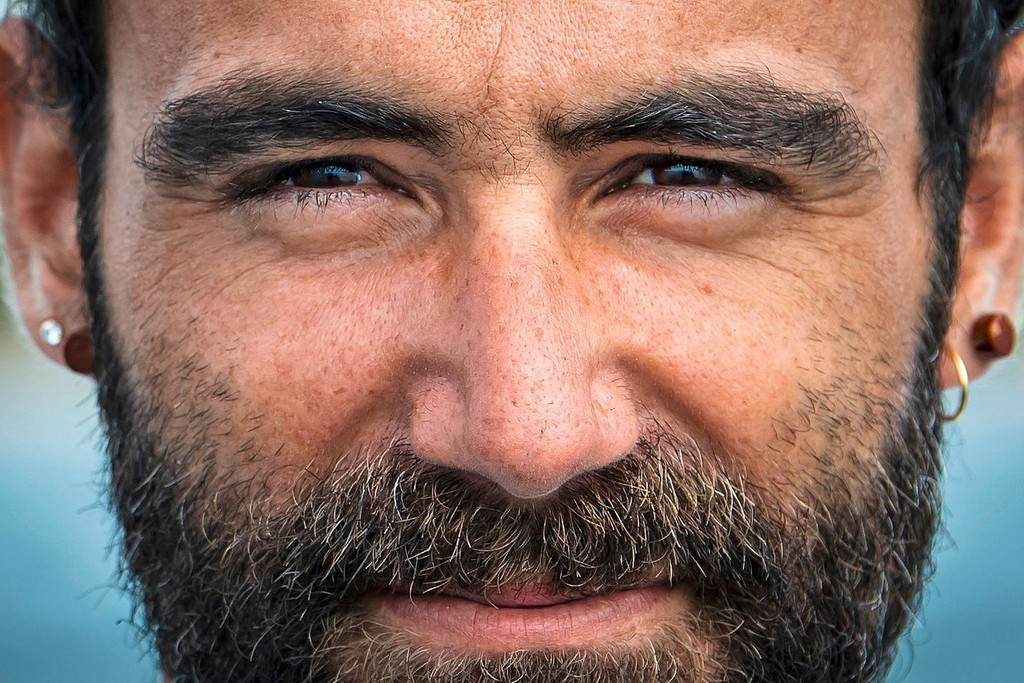
Genevan by adoption Rudi Berli is to replace Green National Councillor Nicolas Walder in Berne. His election as a Swiss Abroad is very unusual. He has promised to represent his region, the Franco-Vaud-Geneva region of Greater Geneva.
Are there a lot of train connections between Geneva and the French station of Chancy-Pougny? “18 trains a day,” Rudi Berli answers straightaway, seated at his table at home, a beautiful house in the French countryside, 15 minutes’ walk from the Rhône and thus from the Swiss border. “We would never have been able to buy a house in Switzerland,” explains the Zurich native, born in the rural town of Hausen am Albis (Zurich). When he was a child, taking the bus to the big city of Zurich took an hour. Nowadays, it takes half that time. “Everything there is connected and hyper-efficient,” remarks this man of the land who, like other Geneva politicians, feels that Geneva deserves greater consideration, particularly with regard to the development of public transport.
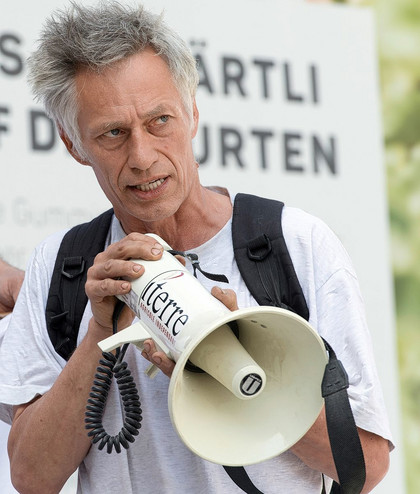
Rudi Berli, as he has expressed his political views up until now: through a megaphone at farmers’ protest meetings. Photo: Keystone
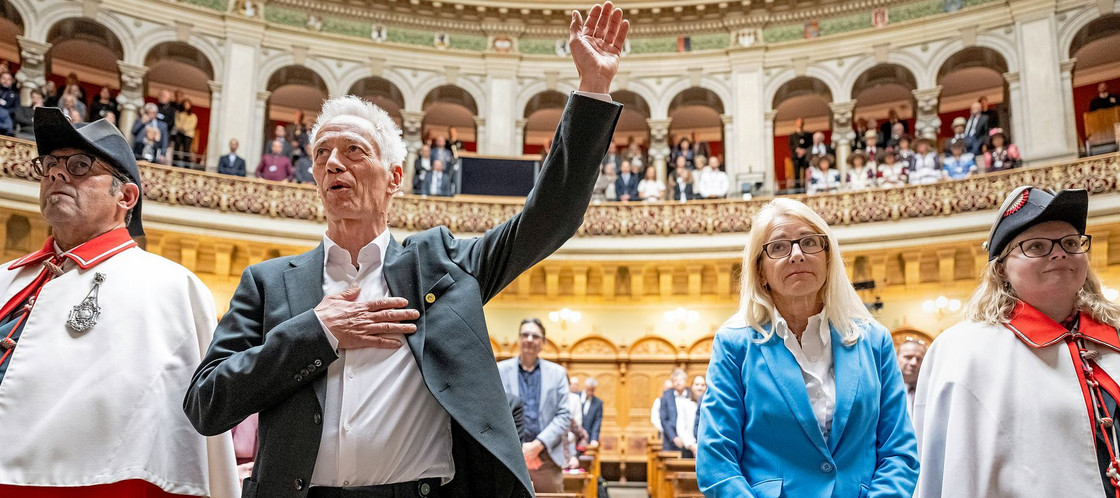
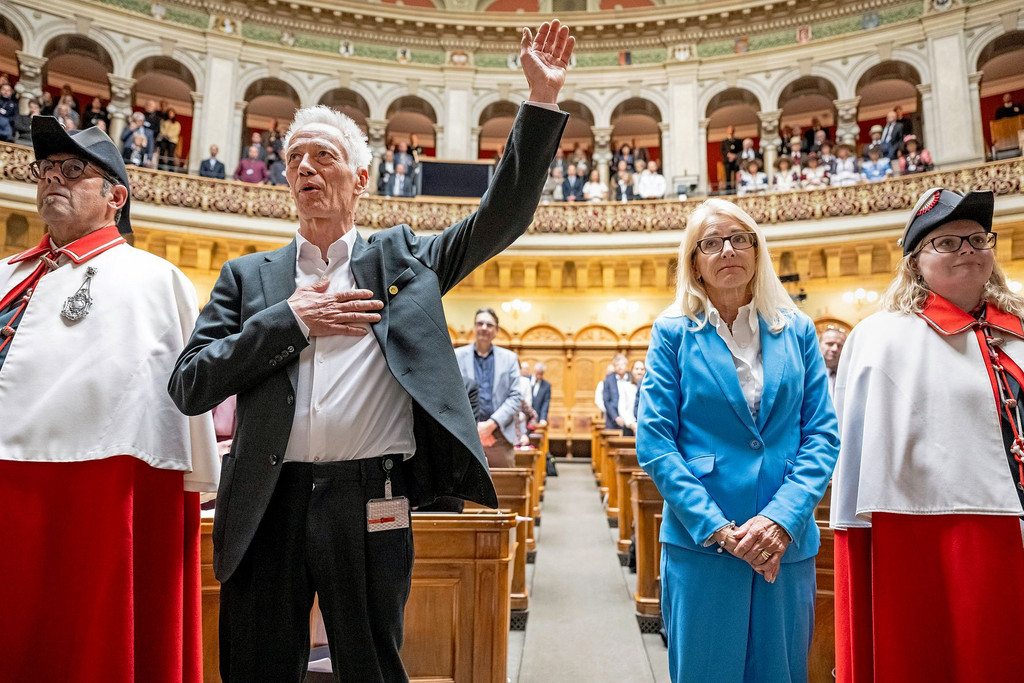
From now on, Rudi Berli will pass on these messages directly to Berne, since he will be replacing his party colleague Nicolas Walder in the National Council. A market gardener, who is employed by the Les Jardins de Cocagne cooperative, Berli sells his organic products in Geneva. Over the summer, he prepared himself for the idea of playing a role in federal politics, after the original deputy, Isabelle Pasquier-Eichenberger, announced she was dropping out. The election of Nicolas Walder to the Geneva Cantonal Council on 19 October then paved his way to the Federal Parliament.
What will Berli do in Berne? The father and family man intends to defend his region and its million inhabitants (residing in Geneva and the surrounding areas in Vaud and France). The village in which he lives, Pougny, reflects the region as a whole. On 14 July, the Swiss cross the Rhône to take part in French national day festivities. On 1 August, the French party in Chancy. “People will go dancing wherever there are dances,” the new National Councillor says. The rural section of the region in France bears host to numerous cross-border workers. These villages share family connections too.
Rudi Berli is not anti-European, but he champions two major principles: the defence of the work of farmers and craftspeople in the region – which he calls relocalisation – and the protection of the products of agriculture through taxes. “It is possible to achieve this, even within the European Union,” he says. Berli, who came to Geneva in 1985 to train at the Lullier School, where he gained several qualifications (fruit tree cultivation, market gardening and landscape gardening, amongst others), describes the world of agriculture as being under pressure. “In this sector you are either badly or very badly paid,” he says, citing the example of dairy farmers earning ten Swiss francs an hour. Swiss farms are dropping like flies, with farmers being wiped out by the workload, debts and the mental strain, the former Uniterre trade unionist says.
The new parliamentarian knows the paradox well: society wants to protect the environment without paying for it. Les Jardins de Cocagne, which prepares a weekly produce basket for its members, has also fallen on hard times. For a few years now, the cooperative has found it hard to reach the minimum 420 subscribers required for the basket service.
“I am a Swiss citizen who lives in Europe.”
Rudi Berli in his own words
For this Zurich native who has fallen in love with French-speaking Switzerland – “the food is better here than in the German-speaking part of the country and, in Geneva, people take their time more” – the solution lies in smart polyculture and livestock cultivation. “The aim is to provide good-quality food locally. This model makes sense with regard to climate hazards, because of its resilience. It means creating an agricultural microcosm that is not being pumped full of fossil and chemical inputs,” the farmer argues. Rudi Berli does not blame the farmers. “No one loves chemicals. Everyone is just trying to make enough profit.”
What does he think of the development of Geneva, overseen for 12 years by his fellow Green representative Antonio Hodgers, the former State Councillor who is accused of having concreted over the canton and defended the construction of 175-metre towers in the emerging neighbourhood of Praille-Acacias-Vernets? “What’s wrong with living in a tower? You get a good view,” the country dweller replies.
Should Geneva, which lets France shoulder some of its housing burden, start building on its arable land? “Absolutely no way.” The farmer ferociously defends this dense central region, rich with verdant countryside. He describes the French territory as pock-marked by housing and retail areas. So where should we build? Rudi Berli evokes the free zone principle, which lets Swiss farmers grow their crops on neighbouring French land but under the Swiss system. He suggests we adopt the same approach for housing, judging that public pension funds could build in the border area. In his view, Switzerland could also invest in infrastructures in France, particularly medical ones, to balance out the region. Geneva, on the other hand, could densify its villa zone and ensure that the richer towns, such as Cologny, which he cites as an example, also build social housing.
The situation has led to a regional crisis, with the Geneva Cantonal Council ruling that the children of people living in France would no longer be able to attend Swiss schools from 2026 onwards. This measure affects 2,500 children. It has ignited tensions between the two countries. Rudi Berli is going to find out what it is like, since one of his own children is affected, and he is not about to give up. “This is a discriminatory, arbitrary decision,” he argues. The National Councillor is furthermore involved with one of the collective appeals from Swiss cross-border workers against the canton of Geneva.
“People will go dancing wherever there are dances.”
Rudi Berli on cross-border life
In Berne, Berli will be earning a salary of around 6,000 francs a month, plus expenses, and will have the resources to hire a parliamentary assistant. “You need one in order to be effective,” he says. He would like to “bring the French-speaking Swiss together”, but parliamentary old hands in Geneva have warned him that the atmosphere in the corridors of the Parliament can be toxic. Which language will he speak to win over his peers? “I represent Geneva, so I will be speaking French.” Except perhaps in key moments, following the advice of former Green National Councillor Ueli Leuenberger. Does he see himself as a Swiss Abroad? “I am a Swiss citizen who lives in Europe,” the Genevan counters.
Swiss Abroad politicians in Berne are the exception
Switzerland has seen three of them: National Councillors Stéphanie Baumann (SP, BE/France, 2001–2003), Ruedi Baumann (Green, BE/France, 2001–2003) and Tim Guldimann (SP, ZH/Germany, 2015–2018).
Rudi Berli stood in the 2023 federal elections but did not win, despite receiving almost 12,000 votes. He was the second deputy. He is the fourth Swiss Abroad to be elected to serve in the Swiss Parliament.
Thank you for your comment. Your Comment Added Successfully.
Thank you for your comment. Comments are approved within one to three days.
Oops! Something went wrong, please try again later.
Comments :
Thank you for your comment. Your Comment Added Successfully.
Patricia Evrard, France 15.05.2026 At 07:12
Je souhaite vivement que cet agriculteur pourra mettre en place des projets pour respecter les productions locales qui respectent la planète en tenant compte du rechauffement climatique. Reduire tous ces pesticides qui detruisent la terre et le vivant.........




Comments
Comments :
Je souhaite vivement que cet agriculteur pourra mettre en place des projets pour respecter les productions locales qui respectent la planète en tenant compte du rechauffement climatique. Reduire tous ces pesticides qui detruisent la terre et le vivant.........