At the second attempt, voters narrowly endorsed the introduction of digital IDs (e-ID). This has positive implications for e-voting. Popular initiatives launched by digital petition may also be possible in future.
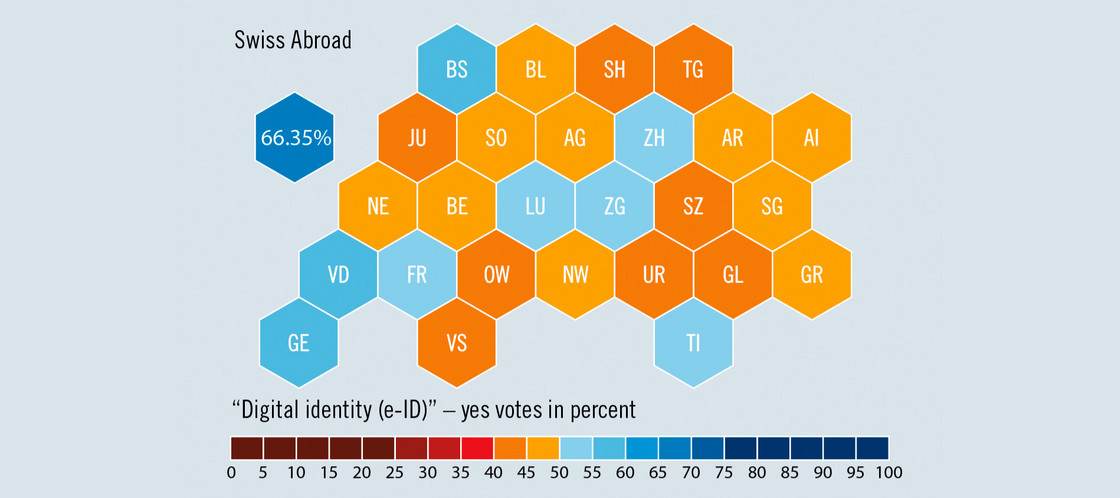
The result was a cliffhanger of the type rarely seen in Switzerland. On 28 September 2025, a whisker-thin ballot-box majority of 50.34 per cent voted in favour of digital IDs (e-ID). Many of the yes votes came from Swiss Abroad, 63.93 per cent of whom gave a clear endorsement to the federal act that will pave the way for e-ID (see also “Swiss Review” 5/25). The result would have been even closer without expatriates having their say: only 50.14 per cent would have voted yes.
No one had expected such a nail-biter. There had been relative unanimity across the political spectrum, with both the Federal Council and a parliamentary majority approving the legislation. Only the SVP and EDU were categorically against it. Why the photo finish if the result was supposed to be a foregone conclusion? Opponents of the bill say it was due to lack of trust in politics and the state. Political experts cite general unease about the rise of digitalisation. According to Lukas Golder of the GfS research institute in Berne, the pressure to modernise explains why Switzerland’s cities voted yes to e-ID. People in rural areas were more sceptical.
Good news for the “Fifth Switzerland”
It is no surprise that Swiss Abroad were more in favour of e-ID than the rest of the electorate. With e-ID, they will be able to enjoy convenient online access to government services around the clock, regardless of where they are in the world. They will benefit increasingly from end-to-end digital services. E-voting, which may become completely paper-free one day, is one example. Swiss who live abroad would no longer have to rely on their identification code arriving by post on time. They may also be able to sign digital petitions for popular initiatives and referendums in future, thanks to the digital collection of signatures, known as “e-collecting”.
The Organisation of the Swiss Abroad (OSA) is delighted by what it calls an “important result for the ‘Fifth Switzerland’”. The referendum has seen one of its key wishes fulfilled. “Thanks to the yes vote, e-ID will now make it easier for people to communicate with Switzerland’s public authorities, irrespective of where they live,” says OSA Director Lukas Weber. The OSA hopes that simplified identification processes will also enable better access to private-sector services – particularly banking.
Following the tight result, Justice Minister Beat Jans hopes to win the trust of those who voted no. Photo: Keystone
Relief for the government
Federal Councillor and Justice Minister Beat Jans is also relieved that e-ID has been approved, explaining that the importance of online interaction is growing, as is the need for security. “In the offline world, so to speak, we like to know who we are dealing with. Why should that be different in the online world?” Jans said that the Federal Council had worked intensively and consulted with other parties to prepare for the introduction of e-ID – and that this groundwork had paid off at the ballot box. He will continue to oversee these efforts but takes misgivings from the no camp seriously. “We will have to try to win over the sceptics.” Jans also vowed to keep digital IDs voluntary.
This is precisely what opponents of e-ID want. Critics say that they will follow implementation of the scheme closely. “I will fight any further proposals to make digital mandatory,” said the SVP National Councillor Lukas Reimann, who noted that nearly half of voters rejected e-ID. Parliament, the Federal Council, and public authorities must apply the brakes, he added. Monica Amgwerd, who headed the no campaign and is the general secretary of the Digital Integrity party, also wants guarantees on data privacy and security to be enshrined in law. “These would go some way to placating the other 50 per cent who voted no,” she says.
Still a lot to do
On 28 September 2025, voters approved a system that provides a trustworthy technical and organisational platform for data sharing. This infrastructure will also enable public authorities and the private sector to issue other electronic credentials, such as driving licences, residence certificates, criminal records excerpts, and degree certificates. E-ID should be available from the third quarter of 2026. There is still a lot to do until then, says Rolf Rauschenbach, who is the e-ID information officer at the Federal Office of Justice. The federal government must work to ensure that the infrastructure operates in accordance with the law. All stakeholders that use e-ID or wish to issue their own electronic credentials will then have to fulfil their responsibility. Rauschenbach: “At the end of the day, we need to convince the general public of the everyday benefits of using e-ID.”
Homeowner tax to be abolished
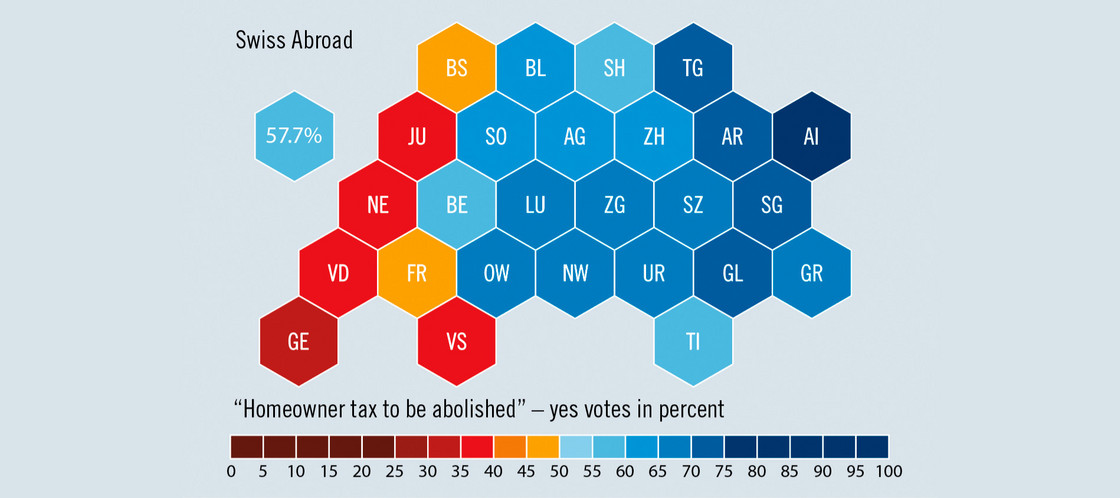
There was less opposition to the second voting proposal on 28 September, with 57.7 per cent of the electorate approving the abolition of a tax that homeowners must pay on property they live in (imputed rental-value tax). Majorities in German- and Italian-speaking Switzerland favoured a reform of home ownership taxes, while voters in French-speaking Switzerland saw it differently. This divide had already become apparent during the voting campaign. Conservative federal parliamentarians in French-speaking Switzerland were also against abolishing the tax – unlike their colleagues from other parts of the country. People would invest less in their properties and the construction industry would suffer, they warned.
It was more the principle behind the tax itself that came under debate in German-speaking Switzerland, where there was disagreement over whether the levy was fair. Ultimately, the majority of voters decided that it was not. The Swiss Abroad emphatically agreed, with 61.3 per cent supporting the amendment, which also abolishes tax deductions on mortgage interest payments and maintenance costs. The changes will come into force in 2028 at the earliest. Furthermore, the amendments will also give cantons the green light to tax holiday homes – a concession to the Alpine regions, which had consistently opposed abolishing the homeowner tax until now.
Thank you for your comment. Your Comment Added Successfully.
Thank you for your comment. Comments are approved within one to three days.
Oops! Something went wrong, please try again later.
Comments :
Thank you for your comment. Your Comment Added Successfully.
Rudolf Megert, Rio de Janeiro, Brasilien 06.01.2026 At 18:00
E-ID: Diesen Zug hab ich bis dato verpasst. Zu wissen, wie diese funktionieren soll, wäre wohl das Wichtigste, um uns allen eine Einsicht zu geben, ob das noch mehr IT-Schrott ist, der nie wirklich sicher ist oder ob wir dann bei jedem Wechsel von einem Smartphone, Tablet, Laptop, Desktop, Toilettenspühlung auf ein neues Gerät mit unendlichen Umständen konfrontiert werden etc. etc.














Comments
Comments :
E-ID: Diesen Zug hab ich bis dato verpasst. Zu wissen, wie diese funktionieren soll, wäre wohl das Wichtigste, um uns allen eine Einsicht zu geben, ob das noch mehr IT-Schrott ist, der nie wirklich sicher ist oder ob wir dann bei jedem Wechsel von einem Smartphone, Tablet, Laptop, Desktop, Toilettenspühlung auf ein neues Gerät mit unendlichen Umständen konfrontiert werden etc. etc.