The Swiss education system is known for its permeability and enables flexible education and training pathways. Vocational apprenticeships are particularly popular. And following an apprenticeship, the path to university studies remains open.
Vocational apprenticeship as a base and starting point
Around two thirds of all young people in Switzerland opt for a vocational apprenticeship after compulsory schooling. They can choose from about 250 different trades, ranging from technical professions to health and social occupations, as well as commercial or creative roles. The apprenticeship lasts three or four years and concludes with the Federal Diploma of Vocational Education and Training. During training, apprentices typically work three to four days a week in the training company and attend vocational school for one to two days. In this way, they acquire both practical skills and theoretical specialist knowledge. During their training apprentices also receive a modest salary.
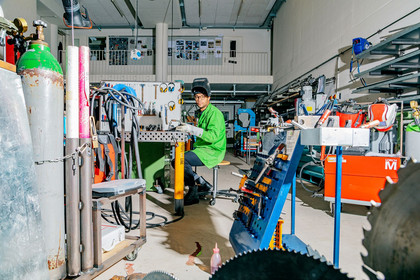
Workshops and studios at Swiss universities of applied sciences, such as the University of Applied Sciences and Arts Northwestern Switzerland, enable students to learn techniques and gain practical know-how. Photo: Pati Grabowicz, Academy of Art and Design Basel, provided
Vocational baccalaureate as a gateway
During or after the apprenticeship, about one quarter of young people complete a vocational baccalaureate, which supplements basic vocational training with expanded general education. This qualification allows graduates to study at a university of applied sciences. Those aiming for a university or one of the Swiss federal institutes of technology (ETH) can achieve access via the supplementary Passerelle exam.
Studying at a university of applied sciences
Universities of applied sciences offer practice-oriented degree programmes in fields such as engineering, business, health, social work, art, design, and music. Like the more research- and theory-oriented universities, they provide a three-year bachelor’s degree followed by a master’s of 3–4 semesters. Some programmes are also offered in English.
Admission to a university of applied sciences generally requires an apprenticeship plus vocational baccalaureate. It is also possible with a high school diploma plus one year of internship in the future field of study. Some universities of applied sciences also offer practice-integrated bachelor’s programmes lasting four years.
A proven system
The combination of a vocational apprenticeship followed by studies at a university of applied sciences is a path that is proving increasingly successful. On one hand, it enables young people to enter the world of work in a practical and flexible manner; on the other, it provides companies with well-trained specialists and managers. This pathway embodies permeability, equal opportunities, and a strong connection between theory and practice—and opens up diverse prospects for the future.
educationsuisse is the umbrella organisation of the 17 Swiss schools abroad recognised by the federal government. educationsuisse advises and supports both young Swiss Abroad and students from Swiss Schools abroad, who wish to pursue their education or training in Switzerland.










Comments