Switzerland could soon be going all out to host the 2038 Winter Olympics and Paralympics, advocating an innovative, decentralised approach to win over the public.
Curling in Geneva, ski jumping in Engelberg, luge in St Moritz. The sporting elite will congregate across the length and breadth of the country at the 2038 Winter Olympic and Paralympic Games – if Swiss organisers get their way. Switzerland is already in “privileged dialogue” with the International Olympic Committee (IOC), reserving it the right to host the Winter Games – if it wants to, and provided it fulfils IOC requirements – without facing competition from other bidders.
“Switzerland’s unique plan offers an alternative to expensive, outsized venues, proposing a smaller and more sustainable Olympics and Paralympics.”
Ruth Wipfli Steinegger, co-chair of Switzerland 2038
“We have a real chance,” says Ruth Wipfli Steinegger, co-chair of the Switzerland 2038 bid, who explains that Switzerland was granted this exclusive arrangement after impressing the IOC with a unique plan that aims to show that there is an alternative to expensive, outsized venues. “The Games will be smaller and more sustainable.”
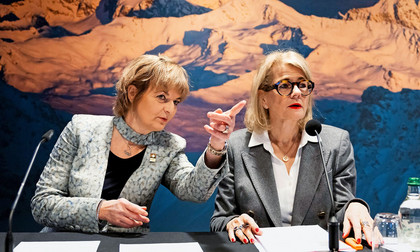
Ruth Metzler-Arnold, president of Swiss Olympic, left, and Ruth Wipfli Steinegger, co-chair of Switzerland 2038 – pictured here shortly before hosting a Switzerland 2038 press conference to update the media on the “Olympic and Paralympic Winter Games in Switzerland” bid. Photo: Peter Klaunzer, Keystone
Switzerland 2038 wants to make use of existing sports and transport infrastructure, with the games spread across all parts of the country and all four language regions. The idea is to have eight venues, with athletes based in three distinct geographic hubs: French-speaking Switzerland, Lucerne, and Grisons. It would be the first time there is a host country instead of a host city or region. For Ruth Metzler-Arnold, president of Swiss Olympic and a former federal councillor, this is a “project for the whole of Switzerland” and its inhabitants, contributing to society far beyond the duration of the Games itself.
Olympic scepticism
Yet voters were less enamoured by similar plans not so long ago, fearing spiralling costs for host municipalities as well as mass tourism and a damaging environmental footprint. Local projects in Grisons and Valais fell foul of the electorate in 2013 and 2018 respectively. To minimise adverse effects on the population, organisers are now focusing on a nationwide event that would forgo any new infrastructure and rely on the private sector to provide over 80 per cent of the necessary outlay and cover future losses. The federal government would have to come up with about 200 million Swiss francs, with cantons and municipalities contributing the same amount.
Switzerland must submit its candidacy in 2027, so time is of the essence. Parliament is expected to vote on the project by the end of the year, so that the bid can be submitted officially to the IOC thereafter. There will also be votes at cantonal and local level, but these plebiscites are likely to take place after the IOC has already named Switzerland as the host. If individual cantons or municipalities reject the project, any affected Olympic discipline would have to move to a different venue. Yes, we have the flexibility to do this, says Ruth Wipfli Steinegger. “We also have a lot of convincing to do – at all levels of society.”




![[Translate to English:]](/fileadmin/_processed_/3/5/csm_fussballer-cover_8abd862050.jpg)
Comments