Menu
stage img
  • Politics

Initiative for a future | Should the super-rich bankroll the fight against climate change?

03.10.2025 – Theodora Peter

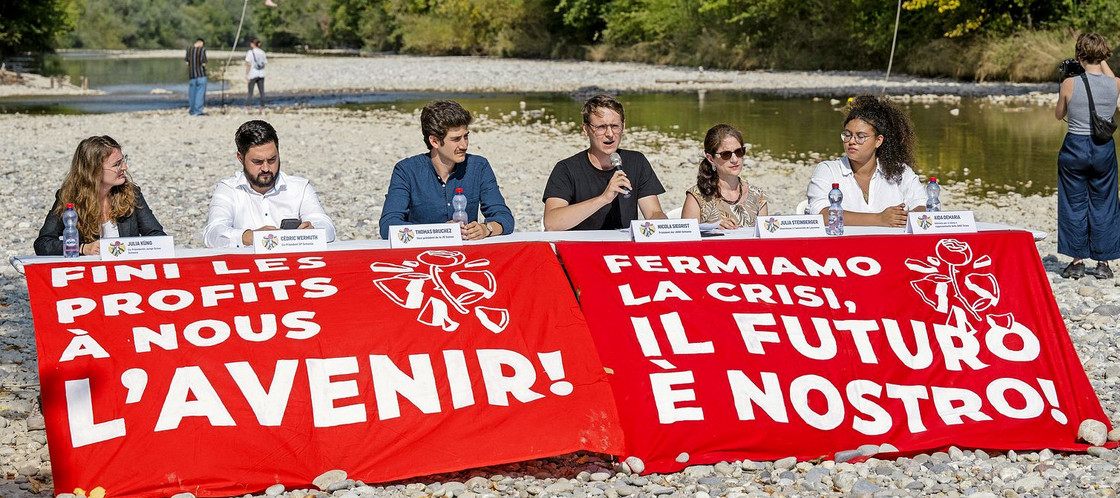
The Young Socialists (JUSO) believe that people in Switzerland who inherit 50 million francs or more should pay a hefty tax on their estates to help fund the fight against climate change. Their controversial “Initiative for a future” will be put to voters on 30 November 2025.

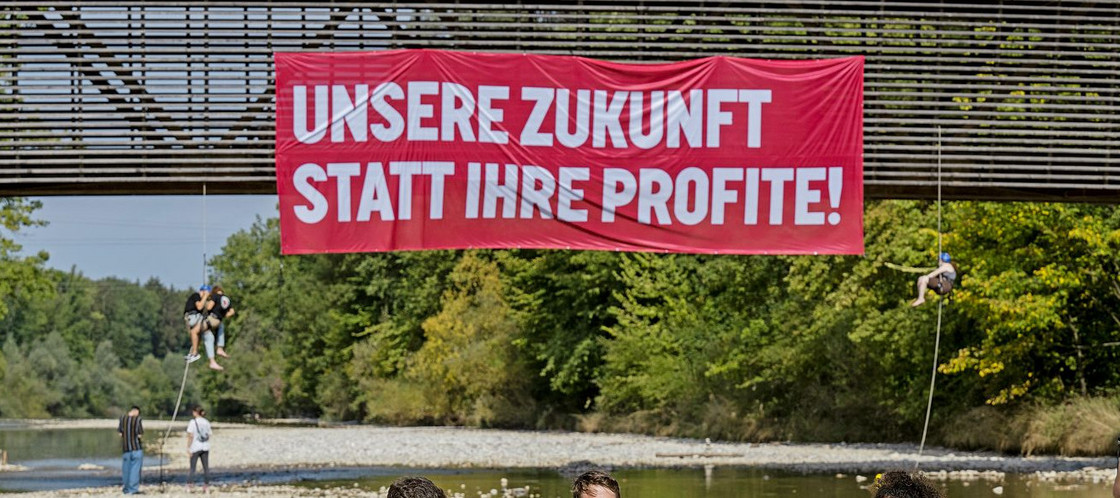
In spring 2024, the Young Socialists (JUSO) – the youth wing of the Swiss Social Democrats (SP) – launched an initiative proposing an additional inheritance tax on estates and endowments worth 50 million Swiss francs or more. JUSO says it wants to “make the rich pay for climate change”, adding: “The super-rich are destroying our future. With their private jets, superyachts and billion-dollar investments in polluting industries, they produce more carbon within a few hours than the average person would in their entire lifetime.”

Those who inherit less than 50 million francs are not the target of the proposal. But anything over and above this amount would incur a 50 per cent tax, i.e. the state would take half of all the assets. According to the proposal, up to six billion francs in additional tax revenue would be raised every year as a result. Its supporters want the money to be spent on “socially equitable measures to fight climate change” and the “ecological restructuring of the economy”.

Tackling climate change requires the super-rich to pay their fair share, argues JUSO President Mirjam Hostetmann. Photo: Keystone

JUSO President Mirjam Hostetmann explains that billions of francs in investment will be needed in the years ahead to combat climate change. “Without the super-rich paying their fair share, the wider population will have to foot the bill,” she says.

Entrepreneurs threaten to leave Switzerland

According to a study by the University of St Gallen, the initiative affects around 2,900 taxpayers across the country who own total assets worth 560 billion francs – or 20 per cent of all taxable wealth in Switzerland. The authors of the study believe that some of these high-net-worth individuals could leave Switzerland in order to avoid paying the tax, meaning that a lot less would go into the state coffers: up to a billion francs per year.

Stadler Rail supremo Peter Spuhler, a high-profile opponent of the initiative, has threatened to move abroad. Photo: Keystone

Some of the super-rich who would have to pay the tax have reacted in horror. Business magnate Peter Spuhler, one of Switzerland’s richest people with an estimated wealth of four billion francs, calls the initiative a “blatant act of confiscation”. Spuhler, who is chairman of the board of directors of train manufacturer Stadler Rail, even warned in a newspaper interview that he would emigrate to Austria, where there is no national inheritance tax. In Switzerland, his eventual heirs would have to fork out at least 1.5 billion francs in inheritance tax if voters approved the initiative. Absurd, says Spuhler. “Look at my bank balance and you would be surprised. Nearly all of my wealth is invested in my companies and in other smaller firms.” He would have to sell his businesses to pay the tax. In the worst case, these would end up in the hands of foreign investors. Such fears are unfounded, say those who champion the initiative. Mirjam Hostetmann countered his remarks, pointing out that it would be possible to pay the tax in instalments or take out loans to cover the bill.

Economist Volker Grossmann, who is a professor of economics at the University of Fribourg, disagrees that taking on new debt is problematic for family companies, provided business is going well. “The economic impact has been completely exaggerated,” he told the tabloid newspaper “Blick”. Taxes are not the only criterion for a location’s attractiveness – Switzerland also has other benefits. Grossmann calls inheritance tax “the least painful tax of all”, because inheritors don’t earn the assets bequeathed to them but are simply in the fortuitous position of having been born into wealth.

A repeat of 2015?

The Federal Council and the conservative majority in parliament flatly reject the initiative. They say it would make Switzerland less attractive as a domicile for wealthy individuals, not least given that the rich already contribute a lot to public finances through wealth tax. One per cent of taxpayers pay over five billion francs, or nearly 40 per cent of direct federal tax revenue.

The initiative would affect around 2,900 taxpayers, who own total assets worth 560 billion francs – or 20 per cent of all taxable wealth in Switzerland.

The SP and the Greens are the only parties supporting the initiative, arguing that the gap between rich and poor is growing. Given the political balance of power, it would be astonishing if the proposal were to be approved at the ballot box. According to a poll conducted in August 2024 by the free newspaper “20 Minuten”, 58 per cent of voters are against the initiative. No updated poll was ready at the time of our editorial deadline.

Ten years ago, a left-wing initiative to introduce inheritance tax at federal level was clearly rejected, with 71 per cent saying no. The aim back then was to charge 20 per cent tax on estates worth two million francs and upwards – to help fund the state pension. The new scheme would now target the super-rich.


Variation from canton to canton

Inheritance tax already exists at cantonal level, albeit in different forms. No such tax exists in Schwyz or Obwalden, while spouses and direct descendants are mostly exempt in all the other cantons. Tax rates vary considerably, from 0 to 49 per cent, depending on the canton.

Neighbouring countries also take different approaches. The German system uses progressive tax rates but grants numerous exceptions, on company assets for example. In Austria, inheritance tax at federal level was abolished completely in 2008. Italy, meanwhile, has a relatively low inheritance tax rate of four per cent and offers tax breaks to attract high-net-worth individuals. France is the most expensive place to inherit wealth, with tax rates of up to 45 per cent depending on the size of the estate. If you inherited 100 million euros, you would have to pay the French state 45 million euros. This is much more than what JUSO is proposing for Switzerland: after deducting the tax-free amount, you would receive a tax bill of 25 million francs for the same amount.

The initiative aims to prevent a situation in which the super-rich would be able to dodge the new inheritance tax by moving to a different country. It proposes a legally contentious retroactive clause to this effect, which the Federal Council has already said would be unworkable in its current form.

On 30 November, voters will decide whether that becomes an issue.


We will review the popular votes of 28 September 2025 in the next edition of our magazine.

Overview of the votes on 30 November

Public service for all: The aim of this initiative is that all citizens do public service for the benefit of the community and the environment – whether this be in the military or civilian context (see Switzerland to vote on public service for all).

National inheritance tax: This initiative foresees a 50 per cent tax on inheritances and endowments worth 50 million francs or more, with the proceeds going to fund the fight against climate change (see main text).

Comments

×

First name, surname and place/country of residence is required

Enter valid name

Valid email is required!

valid email address required

Comment is required!

Comment rules have to be accepted.

Please accept

* These fields are required.

top